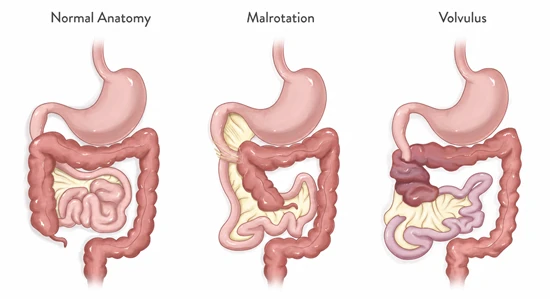
Intestinal Malrotation in children is a congenital condition in which the intestines do not develop or rotate properly inside the abdomen before birth. Normally, during fetal development, the intestines rotate and settle into their correct position inside the abdominal cavity. In children with intestinal malrotation, this normal rotation does not occur properly.
Because of this abnormal positioning, the intestines may become twisted or blocked, which can affect the blood supply to the bowel. In severe cases, the intestine may twist around itself, a dangerous condition known as volvulus. This can cut off blood flow to the intestines and become a surgical emergency.
Intestinal malrotation is most commonly diagnosed in newborns and infants, although some children may develop symptoms later in childhood. Early diagnosis and timely treatment are important to prevent serious complications.
The symptoms of intestinal malrotation may vary depending on the severity of the condition and whether volvulus develops.
Common symptoms of intestinal malrotation in children include:
Bilious vomiting in infants is considered a medical emergency and requires immediate evaluation.
Intestinal malrotation develops during fetal growth before birth.
The condition occurs when the intestines fail to rotate and fix normally inside the abdomen during early pregnancy.
Common causes and contributing factors include:
In most cases, the exact cause is not clearly known.
Certain factors may increase the risk of intestinal malrotation.
Risk factors include:
Some children may have associated congenital conditions.
If untreated, intestinal malrotation may lead to severe complications.
Doctors use several tests to diagnose intestinal malrotation and detect volvulus.
Diagnosis may include:
An upper GI contrast study is one of the most important tests used to confirm intestinal malrotation.
Treatment usually requires surgery because of the risk of volvulus.
Children with volvulus require immediate surgery to untwist the intestine and restore the blood supply.
The most common surgery for intestinal malrotation is called the Ladd procedure.
During this surgery:
If part of the intestine loses its blood supply, damaged sections may need to be removed.
Most children recover well after proper surgical treatment.
Parents are usually advised to:
Recovery time depends on the severity of the condition and whether bowel damage occurred.
Helpful care measures include:
Early treatment improves long-term outcomes.
Parents should seek immediate medical attention if the child develops:
Early diagnosis of intestinal malrotation in children can prevent life-threatening complications.
Yes, severe cases may lead to volvulus and loss of blood supply to the intestines.
Volvulus occurs when the intestine twists around itself and blocks blood flow.
Yes, it is a congenital condition that develops before birth.
Most children require surgery to prevent serious complications.
The Ladd procedure is the standard surgery used to treat intestinal malrotation.
Yes, many children recover well with early diagnosis and timely treatment.
Dr. Muni Varma is an experienced Pediatric Surgeon specializing in the diagnosis and treatment of intestinal malrotation and other complex congenital gastrointestinal conditions in children. With expertise in neonatal surgery, emergency pediatric abdominal surgery, and minimally invasive procedures, Dr. Varma provides advanced child-focused care using modern surgical techniques. From emergency management of volvulus to corrective intestinal surgery and long-term follow-up, he focuses on protecting bowel health, preventing complications, and ensuring healthy growth and recovery in children. Early expert treatment and timely surgery help achieve better outcomes and long-term well-being.