Pediatric Laparoscopic Nissen Fundoplication Surgery is a procedure used to treat severe or persistent gastroesophageal reflux when a child continues to have significant symptoms despite appropriate medical treatment. Gastroesophageal reflux occurs when stomach contents move back into the esophagus, the tube that carries food from the mouth to the stomach.
Many children experience occasional reflux that improves as they grow. However, some children develop gastroesophageal reflux disease (GERD) that can cause repeated vomiting, feeding difficulties, poor weight gain, respiratory problems or damage to the esophagus.
Nissen fundoplication is a surgical procedure that strengthens the natural barrier between the stomach and esophagus to reduce abnormal reflux. The laparoscopic approach uses small incisions and a camera to perform the operation.
Dr. Muni Varma evaluates children with persistent reflux symptoms and considers their symptoms, medical history, investigations and response to treatment before recommending surgery.
Gastroesophageal reflux occurs when stomach contents flow backward into the esophagus.
Some reflux is normal in babies because their digestive system is still developing. It often improves as the child grows.
When reflux becomes frequent, severe or causes complications, it may be diagnosed as gastroesophageal reflux disease (GERD).
GERD is reflux that causes troublesome symptoms or complications.
Children with significant GERD may experience:
Symptoms can vary depending on the child’s age.
Several factors can contribute to gastroesophageal reflux.
These may include:
Children with neurological impairment may have more severe or persistent reflux and may require specialized evaluation.
Most children with reflux do not require surgery.
Nissen fundoplication may be considered when GERD is severe or persistent and appropriate medical and nutritional management has not provided adequate control.
Surgery may be considered in selected children with:
The decision is individualized and depends on the child’s overall health and the underlying cause of reflux.
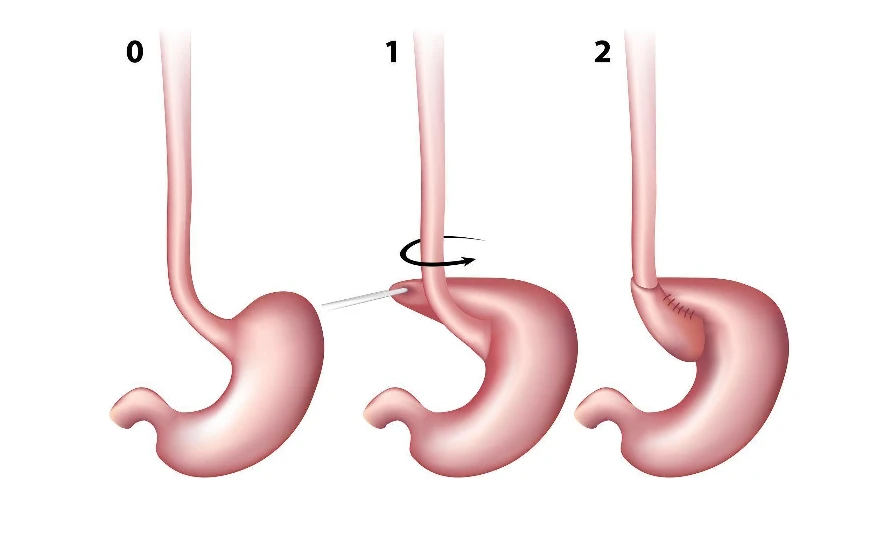
Nissen fundoplication is a surgical procedure that strengthens the valve-like area between the esophagus and stomach.
During the procedure, the upper part of the stomach, called the fundus, is wrapped around the lower part of the esophagus.
This creates a stronger barrier against stomach contents flowing backward into the esophagus.
Laparoscopic Nissen fundoplication is performed using small incisions rather than one large abdominal incision.
A small camera is inserted into the abdomen, allowing the surgeon to view the stomach and esophagus. Specialized instruments are then used to perform the fundoplication.
The minimally invasive approach can result in smaller surgical wounds and may allow a relatively quicker recovery in appropriate patients.
During surgery, the surgeon first accesses the upper abdomen using laparoscopic instruments.
The area around the lower esophagus is carefully prepared. The upper part of the stomach is then brought around the lower esophagus and secured to create the fundoplication.
The repair is designed to reduce abnormal reflux while allowing food and liquids to pass into the stomach.
The exact surgical technique may vary according to the child’s anatomy and medical condition.
No, Most children with reflux improve with age or can be managed with appropriate medical and dietary treatment.
Surgery is generally reserved for selected children with severe, persistent or complicated GERD when other management approaches have not provided adequate control or when complications make surgical treatment appropriate.
A careful evaluation is important before deciding on surgery.
The evaluation depends on the child’s age and symptoms.
The pediatric team may consider:
Not every child requires every test.
The investigations are selected according to the symptoms and clinical situation.
Severe reflux can sometimes be associated with respiratory symptoms, particularly when stomach contents enter the airway.
Children with significant reflux may experience:
Children with suspected aspiration require careful evaluation because respiratory symptoms can have many causes.
Nissen fundoplication is an established surgical treatment for selected children with severe GERD, but complications can occur.
Potential complications include:
The risk varies according to the child’s underlying condition and the complexity of the surgery.
Recovery varies depending on the child’s age, overall health and reason for surgery.
After the procedure, the child may initially require a modified diet while the surgical area heals.
Parents may receive instructions regarding:
The child may need smaller meals or softer foods during the early recovery period.
Feeding is an important part of recovery.
Some children may initially have difficulty swallowing or feel full quickly after surgery. This usually improves as swelling settles and the digestive system adapts.
The surgical team may recommend gradually progressing from liquids to soft foods and then towards a normal diet.
Children with pre-existing feeding difficulties may require additional nutritional or feeding support.
Nissen fundoplication is intended to reduce significant reflux, but reflux can recur in some children.
The likelihood of recurrence can depend on the child’s underlying condition, anatomy and other factors.
Children with certain neurological or complex medical conditions may have a different long-term course and require ongoing follow-up.
Nissen fundoplication is a surgical procedure that wraps the upper part of the stomach around the lower esophagus to strengthen the barrier against reflux.
It is a minimally invasive form of Nissen fundoplication performed through small abdominal incisions using a camera and specialized instruments.
No. Most children with GERD can be managed without surgery. Fundoplication is considered for selected children with severe, persistent or complicated reflux.
Symptoms may include persistent vomiting, feeding difficulties, poor weight gain, recurrent respiratory problems, aspiration or significant esophageal injury.
Depending on the child’s symptoms, evaluation may include medical history, endoscopy, pH or impedance monitoring, imaging and assessment of feeding and growth.
The procedure is designed to reduce abnormal gastroesophageal reflux, which may reduce reflux-related vomiting. The outcome depends on the child’s underlying condition and the cause of vomiting.
Most children can gradually return to a normal diet after recovery. Some may initially require smaller meals and softer foods.
Yes. Reflux can recur in some children, particularly those with complex underlying medical conditions.
Possible complications include difficulty swallowing, gas and bloating, recurrence of reflux, bleeding, infection and the possibility of additional treatment.
Recovery varies between children. The surgical team provides individualized guidance regarding diet, activity and follow-up.
Dr. Muni Varma offers advanced Pediatric Laparoscopic Nissen Fundoplication Surgery for Children in Lucknow, India. With more than 10 years of experience, he uses a careful and child-focused approach to provide accurate evaluation, appropriate surgical planning, and better long-term care. He offers personalized treatment and follow-up support for children with severe gastroesophageal reflux, helping parents understand the treatment process and providing quality pediatric surgical care in Lucknow, India.
