Pediatric Achalasia Cardia Surgery is used to treat achalasia, a rare condition in which the lower part of the esophagus does not relax properly when a child swallows. As a result, food and liquids can have difficulty passing from the esophagus into the stomach.
Children with achalasia may experience difficulty swallowing, regurgitation, chest discomfort, vomiting or gradual weight loss. Because these symptoms can resemble other digestive problems, diagnosis may sometimes take time.
Treatment aims to improve the passage of food from the esophagus into the stomach by reducing the tightness at the lower esophageal sphincter. Surgical treatment may be considered when symptoms are significant or when other treatment options are not suitable or have not provided lasting relief.
Dr. Muni Varma evaluates children with swallowing and upper gastrointestinal problems and develops a treatment plan based on the child’s symptoms, investigations, age and overall health.
Achalasia is a disorder of the esophagus, the muscular tube that carries food from the mouth to the stomach.
Normally, the lower esophageal sphincter relaxes when a person swallows, allowing food to enter the stomach. In achalasia, this relaxation is impaired and the normal muscular movement of the esophagus may also be affected.
As a result, food and liquids can remain in the esophagus instead of passing normally into the stomach.
The exact cause of achalasia is not completely understood.
The condition is associated with damage or dysfunction of the nerve cells that control movement and relaxation of the esophagus.
Achalasia is uncommon in children, and it can occur at different ages.
It is not caused simply by a particular food or eating habit.
The symptoms may develop gradually and can vary from child to child.
Common symptoms include:
Younger children may have difficulty explaining their swallowing problems and may instead show feeding refusal or become distressed during meals.
Persistent difficulty swallowing should not be ignored.
Parents should arrange a medical evaluation if a child has:
These symptoms can have several causes, so proper evaluation is important.
Diagnosis usually requires a combination of clinical assessment and specialized investigations.
Tests may include:
Esophageal manometry is particularly useful because it measures pressure and muscle activity within the esophagus and can help confirm achalasia.
The exact tests recommended depend on the child’s symptoms and clinical findings.
Treatment is aimed at reducing the resistance at the lower esophageal sphincter so food and liquids can pass more easily into the stomach.
Treatment options may include:
The choice depends on the child’s age, severity of disease, anatomy, available expertise and previous treatment.
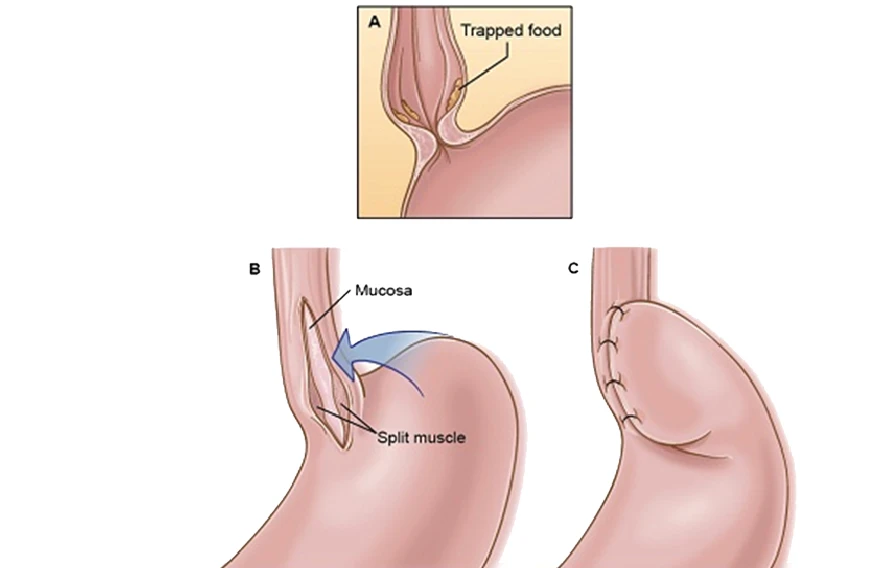
Heller myotomy is a surgical procedure used to treat achalasia.
During the operation, the surgeon carefully divides the muscle fibers of the lower esophageal sphincter. This reduces the tightness at the lower end of the esophagus and allows food to pass more easily into the stomach.
A partial fundoplication may sometimes be performed at the same time to help reduce gastroesophageal reflux after myotomy.
Laparoscopic Heller myotomy is a minimally invasive surgical approach used in selected children with achalasia.
The procedure is performed through small abdominal incisions using a camera and specialized instruments.
The surgeon identifies the lower esophagus and carefully divides the muscles responsible for the abnormal tightness while preserving the inner lining of the esophagus.
The aim is to improve swallowing while minimizing surgical trauma.
Peroral endoscopic myotomy (POEM) is a minimally invasive endoscopic procedure used to treat achalasia.
Instead of making abdominal incisions, an endoscope is passed through the mouth into the esophagus. The surgeon creates a small tunnel within the esophageal wall and divides the muscle fibers responsible for the obstruction.
POEM may be appropriate for selected patients depending on age, anatomy, disease characteristics and available specialist expertise.
Not necessarily, Treatment depends on the severity of symptoms and the child’s overall condition. Some children may be treated using endoscopic procedures, while others may benefit from surgical myotomy.
The aim is to choose an approach that provides effective relief of the obstruction while considering the child’s long-term needs.
Achalasia treatment is generally well established, but every procedure has potential risks.
Possible complications of surgical treatment may include:
The risks vary depending on the procedure and the child’s individual condition.
Recovery depends on the procedure performed and the child’s overall health.
After treatment, the child may initially follow a liquid or soft diet before gradually returning to normal foods.
Parents may receive instructions regarding:
The child’s swallowing and nutritional status are monitored after treatment.
The goal of treatment is to improve swallowing and allow food and liquids to pass into the stomach more easily.
Follow-up is important because some children may develop gastroesophageal reflux or experience recurrent symptoms.
The pediatric surgical and gastroenterology team may recommend follow-up assessments based on the child’s response to treatment.
Yes. Persistent difficulty swallowing can make it difficult for a child to consume enough food and nutrients.
Some children with untreated achalasia may experience weight loss or poor weight gain.
Early diagnosis and appropriate treatment can help improve feeding and nutritional status, although recovery of growth varies from child to child.
Treatment can provide long-term improvement, but symptoms may recur in some children.
Persistent or recurrent swallowing difficulty should be evaluated because it may indicate incomplete relaxation, recurrent narrowing or another gastrointestinal problem.
Regular follow-up helps identify such problems early.
Achalasia is a rare disorder in which the lower esophageal sphincter does not relax normally during swallowing, making it difficult for food and liquids to enter the stomach.
Common symptoms include difficulty swallowing, regurgitation, vomiting, chest discomfort, coughing and poor weight gain.
Diagnosis may involve a contrast study, upper endoscopy and esophageal manometry. Manometry is an important test for confirming the functional abnormalities associated with achalasia.
No. Achalasia is uncommon in children, which can sometimes make diagnosis more challenging.
Heller myotomy is a surgical procedure that divides the tight muscle fibers of the lower esophageal sphincter to improve the passage of food into the stomach.
POEM, or peroral endoscopic myotomy, is an endoscopic treatment in which the muscles causing the obstruction are divided through an internal tunnel created in the esophageal wall.
No. Treatment can include endoscopic procedures or surgery depending on the child’s age, symptoms, disease severity and individual circumstances.
Yes. Difficulty swallowing and eating can result in inadequate nutritional intake, which may lead to weight loss or poor growth.
Food or liquid retained in the esophagus can sometimes enter the airway, potentially causing coughing or respiratory problems.
Treatment aims to provide long-term relief by improving the opening of the lower esophageal sphincter. However, some children may experience recurrent symptoms and require further evaluation or treatment.
Dr. Muni Varma offers advanced Pediatric Achalasia Cardia Surgery for Children in Lucknow, India. With more than 10 years of experience, he uses a careful and child-focused approach to provide accurate evaluation, appropriate surgical planning, and better long-term care. He offers personalized treatment and follow-up support for children with achalasia and related gastrointestinal conditions, helping parents understand the treatment process and providing quality pediatric surgical care in Lucknow, India.
