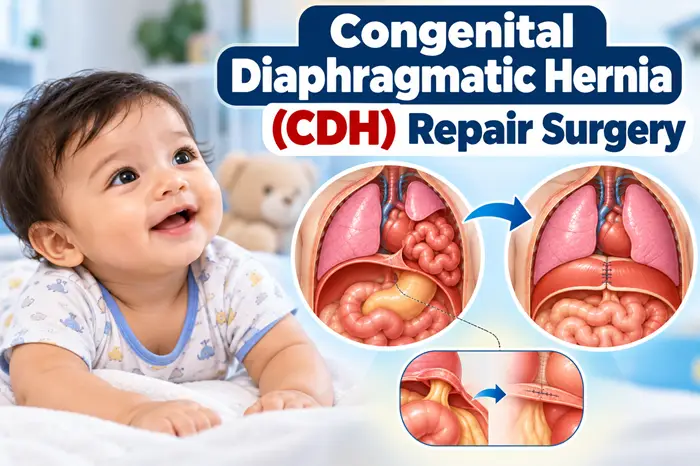
Congenital Diaphragmatic Hernia (CDH) Repair Surgery is used to treat a birth defect in which there is an opening in the diaphragm, the muscle separating the chest from the abdomen. Through this opening, abdominal organs such as the stomach, intestines or liver can move into the chest and interfere with normal lung development.
Children with CDH may develop breathing difficulties, low oxygen levels, rapid breathing or other serious problems shortly after birth. The severity depends on the size and location of the diaphragmatic defect, the organs that have moved into the chest and the development of the lungs.
Treatment usually begins with stabilization of the baby’s breathing and circulation. Once the baby is considered stable enough for surgery, the diaphragmatic defect is repaired, and the abdominal organs are returned to their appropriate position.
Dr. Muni Varma evaluates children with congenital and neonatal surgical conditions and develops a treatment plan based on the child’s condition, investigations, age and overall health.
Congenital diaphragmatic hernia is a birth defect in which an abnormal opening develops in the diaphragm.
Normally, the diaphragm separates the chest from the abdominal cavity. In CDH, abdominal organs can pass through the opening and enter the chest.
This can reduce the space available for the lungs to develop and may result in pulmonary hypoplasia, meaning that one or both lungs are underdeveloped.
CDH most commonly occurs on the left side, although right-sided and bilateral defects can also occur.
The exact cause of CDH is not completely understood.
The condition develops during fetal development when the diaphragm does not form normally.
Some children with CDH may also have other congenital abnormalities or genetic conditions.
CDH is a congenital condition and is not usually caused by something the parents did or did not do during pregnancy.
CDH can be classified according to the location of the diaphragmatic defect.
Common types include:
The size and location of the defect, the organs involved and the development of the lungs can influence the severity of CDH.
Symptoms may appear immediately after birth or become apparent shortly afterward.
Common symptoms include:
Severe CDH can cause significant breathing and circulation problems and requires urgent neonatal care.
Many significant cases of CDH are detected during pregnancy or shortly after birth.
Parents should seek immediate medical attention if a newborn develops:
These symptoms can have several causes, but significant breathing difficulty in a newborn requires urgent medical evaluation.
Diagnosis may occur during pregnancy or after birth.
Tests may include:
A prenatal ultrasound may show abdominal organs positioned within the chest.
After birth, a chest X-ray can help identify the position of the abdominal organs and the effect of the condition on the lungs.
Echocardiography may also be performed because pulmonary hypertension and associated heart abnormalities can affect the baby’s treatment plan.
The exact investigations depend on the child’s condition and clinical findings.
Treatment is not limited to surgery. The first priority is usually to stabilize the baby’s breathing and circulation.
Treatment may include:
The timing of surgery depends on the baby’s clinical condition.
The baby is generally operated on after adequate stabilization rather than simply performing surgery immediately after birth.
CDH repair surgery involves returning the abdominal organs from the chest to the abdominal cavity and closing the opening in the diaphragm.
During surgery, the pediatric surgeon carefully examines the diaphragm and identifies the organs that have moved into the chest.
The stomach, intestines, spleen, liver or other abdominal organs are gently returned to the abdomen.
The surgeon then assesses the size of the diaphragmatic defect.
If the defect is small enough, the edges of the diaphragm may be brought together and closed directly using sutures.
If the defect is large and there is not enough diaphragm tissue for direct closure, a patch may be required.
The aim is to achieve a secure repair while avoiding excessive tension on the diaphragm.
Open CDH repair is a traditional surgical approach and may be used when the baby has a large or complex diaphragmatic defect or when the surgical team requires direct access to the abdominal organs and diaphragm.
The operation is performed under general anesthesia.
A surgical incision is made to access the abdomen or, in selected cases, the chest.
The surgeon carefully identifies the abdominal organs that have moved into the chest and gently brings them back into the abdominal cavity.
The diaphragm is then examined to determine the size and location of the defect.
If the defect can be closed without excessive tension, the edges of the diaphragm are brought together and secured with sutures.
For a large defect, there may not be enough natural diaphragm tissue to achieve direct closure. In such cases, a surgical patch may be used to cover the opening.
After the repair is completed, the surgical team ensures that the abdominal organs are positioned appropriately.
Open surgery provides direct access to the diaphragm and abdominal organs and may be particularly useful in babies with large defects, complex anatomy or other conditions requiring extensive assessment.
Thoracoscopic CDH repair is a minimally invasive approach in which the diaphragmatic defect is repaired through small incisions in the chest using a camera and specialized instruments.
The procedure is performed under general anesthesia.
Small ports are placed through the chest, allowing the surgeon to introduce a camera and surgical instruments.
The abdominal organs that have moved into the chest are carefully identified and returned to the abdominal cavity.
The diaphragmatic defect is then assessed.
If the defect is suitable for minimally invasive closure, the edges may be brought together and repaired using sutures.
A patch may be required when the defect is too large for direct closure.
The thoracoscopic approach avoids a large open incision and may result in smaller scars. However, it is not suitable for every baby with CDH.
Thoracoscopic repair may be considered in carefully selected children who are clinically stable and have anatomy suitable for minimally invasive surgery.
The decision depends on:
Thoracoscopic surgery may not be appropriate in a critically unstable newborn or in some babies with very large or complex defects.
The safest surgical approach is selected according to the individual child rather than using the same technique for every CDH case.
Both approaches have the same fundamental goal: return the abdominal organs to the abdomen and repair the diaphragmatic defect.
Open CDH repair provides direct access to the diaphragm and abdominal organs and may be preferred for large, complex or difficult defects.
Thoracoscopic CDH repair uses small incisions and a camera and may be considered in selected stable children with suitable anatomy.
The choice depends on the baby’s condition, the anatomy of the defect and the experience of the pediatric surgical team.
A patch may be required when the diaphragmatic defect is too large to be closed directly.
During patch repair, the surgeon places a suitable surgical material over the defect and secures it to the remaining diaphragm tissue.
The purpose is to create a stable separation between the chest and abdominal cavities.
Patch repair is more commonly considered for large defects where there is insufficient native diaphragm tissue for a tension-free closure.
Children who require patch repair may need closer long-term follow-up because larger defects can carry a higher risk of recurrence.
No.
Although surgery is an important part of definitive treatment, immediate surgery after birth is not always appropriate.
Babies with CDH may have underdeveloped lungs and pulmonary hypertension. Their breathing and circulation may need to be stabilized before an operation can be safely performed.
The neonatal and surgical teams monitor the baby’s condition and determine when the child is sufficiently stable for repair.
CDH repair is an established surgical treatment, but it can be complex because the condition may affect the lungs and circulation.
Possible complications may include:
The risks vary depending on the size of the defect, lung development, associated conditions and the child’s overall health.
Recovery depends on the severity of CDH, the surgical approach and the baby’s condition before and after surgery.
After repair, the baby may continue to require respiratory support and intensive neonatal monitoring.
Feeding is usually introduced gradually according to the child’s recovery.
Parents may receive instructions regarding:
Some babies may require prolonged respiratory or nutritional support while their lungs and overall condition improve.
The goal of treatment is to repair the diaphragmatic defect and support the child’s breathing, feeding and overall development.
Follow-up is important because some children who have had CDH may experience respiratory, nutritional, gastrointestinal or developmental concerns.
The pediatric surgical and neonatal team may recommend follow-up assessments according to the child’s individual needs.
Yes.
One of the major concerns with CDH is that abdominal organs occupying space in the chest can interfere with normal lung development before birth.
This can result in pulmonary hypoplasia.
Some children may also develop pulmonary hypertension, which can affect breathing and circulation.
The degree of lung involvement varies from child to child.
Yes. Recurrence is possible after CDH repair.
The risk may be higher in children with large diaphragmatic defects, particularly when a patch was required for repair.
Parents should attend recommended follow-up appointments and discuss symptoms such as breathing difficulties, persistent vomiting, feeding problems or other concerning symptoms with the child’s medical team.
Congenital diaphragmatic hernia is a birth defect in which there is an opening in the diaphragm, allowing abdominal organs to move into the chest and potentially interfere with lung development.
Symptoms may include breathing difficulty, rapid breathing, low oxygen levels, bluish skin, feeding difficulties and abnormal chest or abdominal appearance.
CDH may be diagnosed during pregnancy through ultrasound or fetal MRI. After birth, chest X-ray, echocardiography and other investigations may be used.
No. The baby is generally stabilized first. Surgery is performed when breathing, circulation and the overall condition are considered sufficiently stable.
The surgeon returns the abdominal organs to the abdominal cavity and closes the diaphragmatic defect. The defect may be closed directly with sutures or repaired using a patch when it is too large for direct closure.
Open CDH repair uses a surgical incision to provide direct access to the diaphragm and abdominal organs. It may be used for large, complex or difficult defects.
Thoracoscopic CDH repair is a minimally invasive technique performed through small chest incisions using a camera and specialized instruments. It may be considered in selected stable children with suitable anatomy.
No. The approach depends on the baby’s stability, lung condition, pulmonary hypertension, size and location of the defect and overall anatomy.
A patch repair uses surgical material to close a large diaphragmatic defect when there is not enough natural diaphragm tissue for direct closure.
Yes. Recurrence can occur after repair, particularly in children with large defects or those requiring patch repair. Regular follow-up is important.
Dr. Muni Varma offers advanced Congenital Diaphragmatic Hernia (CDH) Repair Surgery for Children in Lucknow, India. With more than 10 years of experience, he uses a careful and child-focused approach to provide accurate evaluation, appropriate surgical planning, and better long-term care. He offers personalized treatment and follow-up support for children with congenital diaphragmatic hernia and related neonatal surgical conditions, helping parents understand the treatment process and providing quality pediatric surgical care in Lucknow, India.
