Pediatric Tracheoesophageal Fistula (TEF) Repair Surgery is an operation performed to separate an abnormal connection between the trachea (windpipe) and esophagus (food pipe) and restore the normal pathway for breathing and feeding. In many newborns, TEF occurs together with esophageal atresia, in which the esophagus does not form a continuous passage to the stomach.
The main goals of surgery are to close the abnormal connection, reconnect the esophagus when possible, and establish a safe pathway for food and saliva to reach the stomach.
The surgical approach depends on the type of TEF, whether esophageal atresia is present, the distance between the two ends of the esophagus, the baby’s overall condition, and associated abnormalities.
In suitable newborns, repair may be performed through an open thoracic approach or a thoracoscopic approach, depending on the baby’s anatomy and the expertise of the pediatric surgical team.
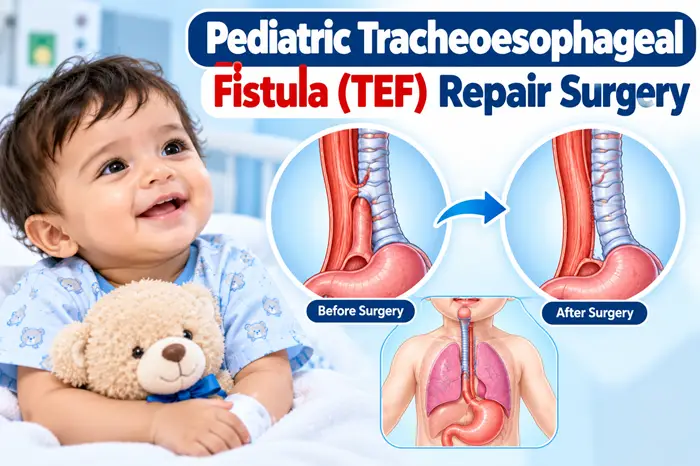
A baby generally requires surgical treatment when an abnormal connection between the trachea and esophagus is confirmed.
Surgery may be planned when:
Newborns with TEF and esophageal atresia usually require specialized neonatal and pediatric surgical care.
The purpose of TEF repair is to eliminate the abnormal connection between the airway and food pipe and restore normal anatomy as safely as possible.
Surgery may help:
Before surgery, the neonatal and pediatric surgical teams assess the baby’s breathing, circulation, feeding status, and overall condition. Imaging and other investigations may be performed to understand the anatomy and identify associated abnormalities.
During the operation, the surgeon identifies the abnormal connection between the trachea and esophagus.
The repair generally involves:
The exact operation depends on the type of TEF and whether the esophagus can be repaired primarily.
An open approach may be used when the baby’s anatomy or clinical situation makes an open operation more appropriate.
Through an incision in the chest, the surgeon accesses the esophagus and tracheoesophageal fistula.
The fistula is carefully identified and divided, and the connection on the tracheal side is closed. If esophageal atresia is present and the esophageal ends can be brought together without excessive tension, the surgeon performs an esophageal anastomosis.
Open repair may be particularly useful in complex cases where direct access is required.
Thoracoscopic TEF repair is a minimally invasive approach performed through small openings in the chest using a camera and specialized instruments.
The surgeon uses the thoracoscopic view to identify and separate the fistula and perform the required esophageal repair.
Potential advantages of a thoracoscopic approach may include:
However, thoracoscopic surgery is technically demanding and is not appropriate for every newborn. The decision depends on the baby’s size, anatomy, clinical condition, and the pediatric surgeon’s assessment.
When TEF occurs together with esophageal atresia, the surgical procedure generally involves both closing the fistula and restoring continuity of the esophagus when possible.
If the gap between the upper and lower esophageal segments is suitable, primary esophageal anastomosis may be performed during the same operation.
When the gap is too large for safe primary repair, treatment may require a different or staged surgical strategy.
The surgical plan is individualized according to the baby’s anatomy and overall condition.
In some babies, the two ends of the esophagus are separated by a significant distance. This is known as long-gap esophageal atresia.
Immediate primary reconnection may not be possible in every case.
Depending on the individual situation, the surgical team may consider a staged strategy designed to preserve the baby’s own esophagus and achieve reconstruction when it becomes safer and technically feasible.
The treatment plan depends on the length of the gap, the baby’s growth, associated conditions, and the condition of the esophageal segments.
When TEF is identified in a newborn, repair is generally considered during the neonatal period after the baby’s condition has been appropriately assessed and stabilized.
The exact timing depends on:
The pediatric surgical team determines the safest timing for each newborn.
TEF repair is a specialized neonatal operation. Like any major surgery, it carries potential risks, particularly because newborns may have associated medical conditions or respiratory problems.
The risks depend on the type of TEF, esophageal anatomy, baby’s overall health, and surgical approach.
Careful monitoring before and after surgery is important because the esophageal and airway repairs need time to heal.
Successful TEF repair may provide several important benefits:
The expected outcome varies depending on whether esophageal atresia is present, the type of repair required, and any associated medical conditions.
TEF repair can have complications, particularly in premature, medically unstable, or complex cases.
Possible complications include:
The pediatric surgical and neonatal teams monitor the baby closely after surgery to identify complications and provide appropriate treatment.
Recovery takes place under close neonatal or pediatric monitoring.
After surgery, the baby may require:
The length of hospitalization varies depending on the complexity of the repair, associated conditions, feeding progress, and recovery.
After discharge, parents should carefully follow the pediatric surgical team’s instructions.
Important aftercare measures may include:
Parents should seek medical attention promptly if the child develops significant breathing difficulty, repeated choking, persistent vomiting, fever, or other concerning symptoms.
Long-term follow-up is important because some children can develop feeding or esophageal problems after TEF repair.
The pediatric surgical team may monitor:
Some children may require additional evaluation or procedures if narrowing of the esophagus or other complications develop.
For newborns and infants, activity is gradually increased according to recovery and the treating team’s recommendations.
As the child grows, most activity decisions depend on:
The pediatric surgeon can provide individualized guidance regarding physical activity and sports as the child becomes older.
Feeding can take time to become established after TEF repair.
Some children may experience:
These problems do not occur in every child, but follow-up helps identify and manage them early.
Feeding should progress according to the recommendations of the neonatal and pediatric surgical team.
A recurrent tracheoesophageal fistula can occur in some children after repair.
Possible warning signs include:
If these symptoms occur, the child should be evaluated by the treating pediatric surgical team.
The cost of Pediatric Tracheoesophageal Fistula Repair Surgery in India varies significantly depending on the baby’s condition and the complexity of treatment.
Factors that can influence the overall cost include:
Parents should discuss the expected treatment plan and estimated expenses with the treating hospital after the baby has been evaluated.
Parents should understand that TEF repair is a specialized newborn surgery and the exact procedure varies according to the baby’s anatomy.
Before surgery, parents should discuss:
The pediatric surgeon can explain the planned operation and expected recovery based on the baby’s individual condition.
It is a surgical procedure used to close the abnormal connection between the trachea and esophagus. When TEF occurs with esophageal atresia, the surgery may also reconnect the two ends of the esophagus.
Yes. TEF is commonly identified during the newborn period, and surgical repair is generally planned after the baby has been assessed and stabilized.
TEF can be repaired through an open chest approach or, in selected babies, through thoracoscopic minimally invasive surgery. The appropriate approach depends on the baby’s anatomy and clinical condition.
Open repair uses a chest incision to access the fistula and esophagus. Thoracoscopic repair uses small chest incisions, a camera, and specialized instruments. Not every baby is suitable for thoracoscopic surgery.
Yes. TEF frequently occurs together with esophageal atresia. When both are present, the operation may involve closing the fistula and reconnecting the esophagus.
Recovery varies depending on the baby’s condition, the type of repair, associated problems, and feeding progress. Newborns often require a period of specialized hospital or NICU care.
Some children may develop feeding difficulties, reflux, or esophageal narrowing after repair. Regular follow-up helps identify and manage these problems.
A recurrent fistula is a possible complication after repair. Persistent coughing, choking, or recurrent respiratory infections may require further evaluation.
Dr. Muni Varma offers advanced Pediatric Tracheoesophageal Fistula Repair Surgery for Children in Lucknow, India. With more than 10 years of experience, he uses a careful and child-focused approach to provide accurate evaluation, appropriate surgical planning, and better long-term care. He offers personalized treatment and follow-up support for children with tracheoesophageal fistula, helping parents understand the treatment process and providing quality pediatric surgical care in Lucknow, India.
