Pediatric Meningocele Repair Surgery is a procedure performed to close a spinal defect in which the protective coverings of the spinal cord, called the meninges, protrude through an opening in the vertebrae and form a fluid-filled sac.
The main goals of surgery are to repair the spinal defect, safely manage the meningocele sac, protect the spinal cord and nerves, prevent cerebrospinal fluid (CSF) leakage, and provide secure tissue coverage over the repaired area.
Unlike meningomyelocele, a typical meningocele primarily contains the meninges and CSF rather than a large amount of neural tissue. However, the anatomy can vary, so detailed imaging and neurological evaluation are important before surgery.
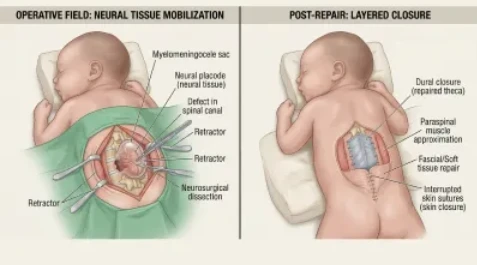
Surgery may be recommended when a child has a meningocele that requires repair.
The surgical team may consider:
The timing of surgery is individualized according to the child’s condition and the characteristics of the spinal defect.
The main objectives of meningocele repair include:
The operation is planned to preserve normal neurological function and avoid unnecessary injury to the spinal cord or nerves.
Before surgery, the child undergoes a detailed neurological assessment and appropriate spinal imaging.
During the procedure:
The exact surgical technique depends on the location, size, and anatomy of the meningocele.
The meningocele sac is carefully handled during surgery.
The surgeon identifies the sac and determines its relationship with the surrounding spinal structures. The abnormal meningeal tissue is managed appropriately, while the underlying neural structures are protected.
The goal is to achieve a secure repair without creating unnecessary pressure or injury to the spinal cord and nerves.
After managing the meningocele, the underlying spinal opening is repaired.
The surgical team aims to create a watertight closure of the meningeal layers to reduce the risk of postoperative CSF leakage.
The surrounding tissues are then closed in layers to provide additional protection.
A secure soft-tissue covering is an important part of the procedure.
The surgeon closes the deeper tissue layers followed by the skin. For larger defects, additional reconstruction may sometimes be required to achieve adequate coverage without excessive tension.
Yes, In a typical meningocele, the protruding sac primarily contains meninges and CSF, while in meningomyelocele, neural tissue and nerve structures are also involved in the protruding sac.
Because of this difference, the surgical repair can be different.
However, some children may have associated spinal cord abnormalities, tethering, or other neural involvement. The final surgical approach therefore depends on the child’s individual anatomy and imaging findings.
Before and after surgery, doctors may evaluate the child for associated spinal conditions.
Depending on the findings, assessment may include:
Not every child requires all of these investigations.
Meningocele repair can be performed safely when the child is appropriately evaluated and the operation is carefully planned.
However, spinal surgery involves delicate structures. The risks depend on:
Potential benefits include:
Early and appropriate repair may help prevent complications related to an open or poorly protected spinal defect.
Potential complications include:
The individual risk depends on the child’s spinal anatomy and associated conditions.
After surgery, the child is monitored closely for wound healing and neurological function.
The medical team may assess:
The length of hospital stay varies according to the child’s age, surgical complexity, and recovery.
Parents should:
Urgent medical evaluation is recommended if the child develops fever, wound opening, persistent fluid leakage, new weakness, seizures, severe pain, or other concerning neurological symptoms.
Follow-up is important even after successful surgical closure.
Depending on the child’s condition, follow-up may include:
The follow-up schedule is individualized.
Some children with spinal dysraphism may have or later develop tethered cord-related problems.
Parents should discuss any new symptoms such as:
If such symptoms develop, further neurological or neurosurgical evaluation may be recommended.
A typical meningocele may have less neurological involvement than meningomyelocele, but associated spinal cord abnormalities can still affect bladder or bowel function in some children.
The child’s bladder and bowel function should therefore be assessed when clinically appropriate.
The timing depends on wound healing, neurological status, and the extent of the operation.
Light activities may be resumed gradually according to the surgeon’s instructions.
Strenuous physical activity, contact sports, and activities that place pressure on the surgical area may need to be restricted until adequate healing has occurred.
Many children can do well after successful repair, particularly when significant neurological involvement is absent.
Long-term monitoring may nevertheless be recommended for:
The need for long-term follow-up depends on the individual child’s condition.
The cost of meningocele repair varies depending on the complexity of the spinal defect and the child’s medical needs.
Factors that may affect the cost include:
Parents should discuss the expected treatment plan and estimated expenses with the treating hospital.
Parents should discuss:
Understanding the child’s individual anatomy helps parents prepare for surgery and recovery.
Pediatric Meningocele Repair Surgery is an operation used to close a spinal defect and repair a meningeal sac containing cerebrospinal fluid.
No. A typical meningocele primarily contains the meninges and CSF, whereas a meningomyelocele also involves neural tissue and spinal nerves. The surgical approach can therefore differ.
No. Neurological function varies. A typical meningocele may have limited neurological involvement, but associated spinal abnormalities can affect function in some children.
A major goal of surgery is to achieve a secure closure that prevents or stops CSF leakage.
Some children may have associated spinal cord abnormalities that affect bladder or bowel function. Evaluation depends on the child’s neurological findings.
Follow-up depends on the individual case. Some children require monitoring for spinal development, tethered cord, neurological function, or bladder and bowel problems.
Tethered cord syndrome occurs when the spinal cord becomes abnormally attached and cannot move freely within the spinal canal. Children with spinal dysraphism may be monitored for related symptoms.
Recovery varies depending on the size and location of the defect, surgical complexity, wound healing, and the child’s overall health.
Dr. Muni Varma offers advanced Pediatric Meningocele Repair Surgery for Children in Lucknow, India. With more than 10 years of experience, he uses a careful and child-focused approach to provide accurate evaluation, appropriate surgical planning, and better long-term care. He offers personalized treatment and follow-up support for children requiring meningocele repair, helping parents understand the treatment process and providing quality pediatric surgical care in Lucknow, India.
