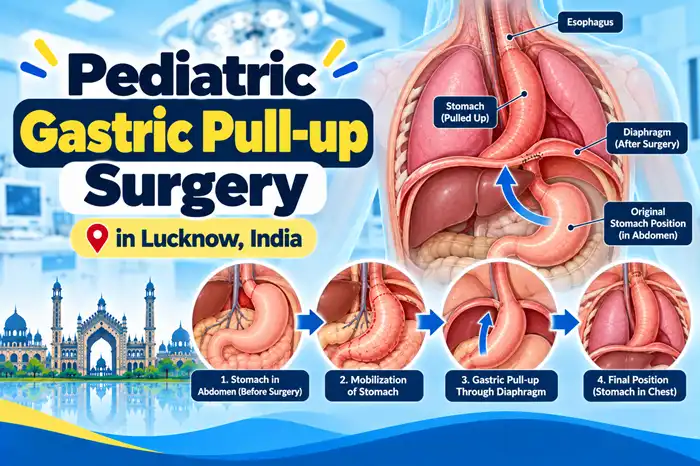
Pediatric Gastric Pull-Up Surgery is a complex reconstructive procedure used to restore the passage of food when the esophagus cannot be repaired directly or is absent, severely damaged, or too short to connect safely to the stomach. During the procedure, the surgeon mobilizes the stomach and brings it upward into the chest or neck to create a new passage for food.
This operation may be considered for selected children with long-gap esophageal atresia, severe esophageal injury, or other complex conditions in which the esophagus cannot be reconstructed using simpler techniques. The choice of procedure depends on the child’s anatomy, previous surgeries, condition of the stomach and esophagus, and overall health.
Gastric pull-up surgery requires specialized pediatric surgical care and careful postoperative monitoring. The treatment plan may involve pediatric surgeons, anesthesiologists, nutrition specialists, and other healthcare professionals.
Gastric pull-up surgery may be considered when the esophagus cannot be safely repaired or reconstructed using other available methods.
Possible indications include:
The procedure is not necessary for every child with esophageal atresia or an esophageal abnormality. The surgical team evaluates whether the native esophagus can be preserved before considering replacement.
The primary goal is to create a functional route for food and liquids to pass from the mouth into the stomach.
Depending on the child’s condition, surgery may aim to:
The results depend on the underlying condition, the child’s anatomy, and postoperative healing. Normal swallowing and feeding cannot be guaranteed.
The operation is performed under general anesthesia.
The surgeon carefully mobilizes the stomach while preserving its blood supply. The stomach is then brought upward through the chest or another planned route and connected to the remaining esophagus or upper digestive tract.
The general steps may include:
The precise technique depends on the child’s anatomy and the reason esophageal replacement is required.
Open gastric pull-up surgery uses an incision to access the abdomen and, when necessary, the chest or neck.
The surgeon mobilizes the stomach, brings it upward, and creates a connection with the remaining esophagus or upper digestive tract.
An open approach may be selected when complex anatomy, previous operations, or the need for extensive reconstruction makes direct access appropriate.
In selected cases, parts of gastric pull-up surgery may be performed using laparoscopic or thoracoscopic techniques.
These approaches are not suitable for every child. The choice depends on the child’s size, anatomy, previous surgeries, clinical stability, and the surgical team’s experience.
In selected children with long-gap esophageal atresia, the two ends of the esophagus are too far apart for a safe direct connection.
The surgical team first assesses whether the child’s own esophagus can be preserved through delayed repair or other reconstructive techniques. If native-esophagus reconstruction is not feasible or appropriate, esophageal replacement may be considered.
Gastric pull-up is one possible replacement option. Other options, such as colon interposition or jejunal interposition, may be considered in selected circumstances.
The best option depends on the child’s anatomy, previous treatment, expected function, and long-term nutritional needs.
The choice of reconstruction is individualized.
Each technique has specific benefits and limitations. Gastric pull-up is not automatically the preferred option for every child requiring esophageal replacement.
The timing depends on the underlying condition and the child’s clinical status.
In children with congenital esophageal abnormalities, the surgical team may first stabilize feeding and breathing, assess the gap between the esophageal ends, and determine whether native-esophagus reconstruction is possible.
For children with severe acquired esophageal damage, timing depends on the extent of injury, inflammation, previous treatment, nutritional status, and readiness for reconstruction.
The operation may be planned after detailed evaluation rather than performed immediately.
Gastric pull-up is a major and technically demanding operation. It may be an appropriate option for carefully selected children, but it carries significant risks.
The surgical team evaluates the child’s overall health, nutritional status, anatomy, previous operations, and available reconstructive alternatives before recommending the procedure.
Specialized anesthesia, intensive postoperative monitoring when needed, and coordinated nutritional support are important parts of care.
Potential benefits include:
The extent of benefit varies. Some children continue to experience swallowing difficulties, reflux, or nutritional challenges after surgery.
Possible complications include:
Because the operation is complex, the treating team discusses individualized risks and the plan for managing complications before surgery.
Recovery may be prolonged and depends on the child’s condition and the complexity of reconstruction.
After surgery, the child is monitored closely for breathing difficulties, infection, leakage, and other complications. Feeding is introduced according to the surgical team’s assessment.
Recovery may include:
The length of hospitalization varies according to the child’s recovery and whether additional treatment is required.
After discharge, parents should follow the individualized instructions provided by the surgical team.
Important measures include:
Do not advance food textures or change tube-feeding schedules without guidance from the treating team.
Regular follow-up is essential to assess the reconstructed food passage and the child’s nutritional progress.
The surgical team may monitor:
Some children may require endoscopic assessment, dilation of a narrowed connection, reflux treatment, or specialized feeding support.
Feeding is introduced gradually according to the child’s recovery and the surgeon’s instructions.
Some children initially receive nutrition through a feeding tube. Oral feeding may begin once the team confirms that the reconstruction has healed sufficiently and swallowing is considered safe.
The feeding plan may include:
Feeding recommendations should be individualized, especially for children with swallowing difficulties or aspiration risk.
Long-term outcomes vary depending on the original esophageal condition, the surgical reconstruction, and the child’s healing.
Some children develop useful oral feeding and satisfactory growth. Others may need ongoing treatment for reflux, swallowing difficulties, anastomotic narrowing, delayed gastric emptying, or respiratory complications.
Long-term care focuses on nutrition, growth, swallowing safety, respiratory health, and quality of life.
The cost varies depending on the complexity of reconstruction and the child’s medical needs.
Factors that may affect the total cost include:
Parents should obtain an individualized estimate from the hospital after the surgical plan and expected postoperative care have been discussed.
Before proceeding, parents should understand why gastric pull-up is being considered and whether the child’s own esophagus can be preserved.
Important questions include:
It is an esophageal replacement procedure in which the stomach is brought upward and connected to the remaining esophagus or upper digestive tract to restore a route for food.
It may be considered when the esophagus cannot be repaired directly, including selected cases of long-gap esophageal atresia or severe esophageal damage.
No. Depending on the child’s condition, native-esophagus reconstruction, colon interposition, or jejunal interposition may be considered.
Some children achieve useful oral feeding, but eating patterns and swallowing function vary. Reflux, swallowing difficulties, and feeding challenges may require ongoing treatment.
Recovery varies according to the child’s condition, surgical complexity, and postoperative progress. Hospitalization and feeding advancement are determined by the treating team.
Yes. It is a complex reconstructive procedure that requires specialized surgical planning, anesthesia, postoperative monitoring, and nutritional support.
Yes. Regular follow-up helps assess swallowing, reflux, growth, nutrition, and the function of the reconstructed food passage.
Dr. Muni Varma offers advanced Pediatric Gastric Pull-Up Surgery in Lucknow, India. With more than 10 years of experience, he uses a careful and child-focused approach to provide appropriate evaluation, surgical planning, and follow-up care. He helps parents understand complex pediatric surgical options and the treatment and recovery process for children requiring esophageal reconstruction.
