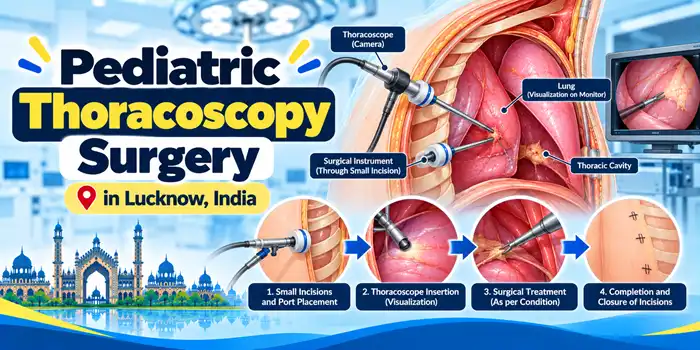
Pediatric Thoracoscopy Surgery is a minimally invasive surgical procedure used to diagnose and treat certain conditions affecting the lungs, pleura, esophagus, diaphragm, and other structures inside a child’s chest. The procedure involves making small incisions in the chest wall and inserting a thin camera called a thoracoscope, along with specialized surgical instruments.
The camera provides a magnified view of the thoracic cavity, allowing the surgeon to perform selected procedures without making the larger incision required for traditional open chest surgery, known as thoracotomy.
Thoracoscopy is also called Video-Assisted Thoracoscopic Surgery (VATS). It may be used for lung surgery, drainage of pleural infections, removal of selected chest masses, repair of certain congenital abnormalities, and other pediatric thoracic procedures.
Compared with open surgery, thoracoscopy may offer smaller incisions, reduced postoperative discomfort, and faster recovery in appropriately selected children. However, not every thoracic condition can be treated thoracoscopically, and open surgery may be necessary for complex cases.
A child may require thoracoscopy when a condition inside the chest needs surgical evaluation or treatment and a minimally invasive approach is considered suitable.
Thoracoscopy may be recommended for:
The decision depends on the child’s age, size, medical condition, imaging findings, and the complexity of the planned procedure.
The main purpose of pediatric thoracoscopy is to provide access to structures inside the chest through small incisions.
Depending on the condition, the procedure may help to:
The specific benefits depend on the procedure performed and the child’s underlying condition.
Pediatric thoracoscopy is performed under general anesthesia.
The child is positioned according to the location of the condition and the operation planned. The surgeon makes small incisions in the chest wall and inserts a thoracoscope and specialized instruments.
The camera displays images of the chest cavity on a monitor, allowing the surgeon to examine the structures and perform the planned operation.
The general steps include:
Depending on the procedure, the anesthesia team may use techniques that help provide adequate space for safe surgery within the chest.
Thoracoscopy can be used for different diagnostic and therapeutic procedures.
Diagnostic thoracoscopy allows the surgeon to directly examine structures inside the chest.
It may be used when imaging and other investigations do not provide enough information to establish a diagnosis.
During the procedure, the surgeon may inspect the pleura, lungs, or mediastinum and obtain a biopsy when required.
Therapeutic thoracoscopy is performed to treat an identified condition.
Depending on the child’s needs, the surgeon may drain infected fluid, remove abnormal tissue, repair certain congenital abnormalities, or perform another planned thoracic procedure.
VATS is the commonly used term for thoracoscopic procedures performed with video-camera guidance.
It allows the surgeon to perform selected chest operations through small incisions while viewing the operative area on a monitor.
Thoracoscopic empyema surgery may be performed when infected fluid or pus accumulates around the lung and requires surgical clearance.
During the procedure, the surgeon may:
Not every child with empyema requires VATS. Antibiotics, chest tube drainage, and intrapleural fibrinolytic treatment may be appropriate in other cases.
Thoracoscopy may be used for selected operations involving the lungs.
Depending on the condition, procedures may include:
The amount of lung tissue removed depends on the diagnosis and the extent of the abnormality.
Some children are born with abnormalities affecting the development of lung tissue.
In selected cases, thoracoscopic surgery may be used to remove abnormal lung tissue while preserving healthy lung structures.
Examples include certain congenital pulmonary airway malformations and pulmonary sequestrations.
The surgical approach depends on the location of the abnormality, vascular anatomy, and the child’s clinical condition.
Thoracoscopy may be used for selected pediatric esophageal procedures.
These can include:
Thoracoscopic esophageal surgery requires careful assessment of anatomy and surgical complexity.
Some children may require open surgery, particularly when the anatomy or clinical condition makes a minimally invasive approach unsuitable.
Thoracoscopy may be used for selected conditions affecting the diaphragm.
Procedures may include:
For diaphragmatic plication, the surgeon places sutures to tighten and flatten an abnormally elevated diaphragm.
For selected diaphragmatic defects, the surgeon may repair the opening using sutures or other appropriate reconstructive techniques.
The approach depends on the child’s condition and the complexity of the defect.
The mediastinum is the central compartment of the chest between the lungs.
Thoracoscopy may be used to evaluate, biopsy, or remove selected mediastinal cysts and masses.
The suitability of minimally invasive surgery depends on the size, location, relationship to nearby structures, and suspected nature of the mass.
Some masses require an open approach or additional treatment.
Thoracoscopy and thoracotomy are different approaches to chest surgery.
| Feature | Thoracoscopy | Thoracotomy |
|---|---|---|
| Surgical access | Small incisions | Larger open incision |
| Visualization | Camera-guided view | Direct surgical view |
| Chest wall disruption | Generally less | Generally greater |
| Postoperative discomfort | May be lower in selected cases | May be greater |
| Recovery | May be faster | May require longer recovery |
| Suitability | Selected thoracic procedures | Complex cases or when direct access is needed |
The choice depends on the procedure, anatomy, surgical findings, and the child’s condition.
Sometimes an operation that begins thoracoscopically must be converted to thoracotomy for safety or to complete the procedure effectively.
Thoracoscopy may be performed in newborns, infants, and older children when clinically appropriate.
The decision depends on factors such as:
Some complex neonatal thoracoscopic procedures require particularly careful anesthesia and surgical planning.
Pediatric thoracoscopy is an established minimally invasive surgical approach for selected chest conditions.
However, it carries risks related to anesthesia, the underlying condition, and the specific operation being performed.
The surgical team evaluates the child’s respiratory status, anatomy, medical history, and expected benefits before recommending the procedure.
For some children, open surgery may provide safer access or better control of a complex problem.
Potential benefits include:
These benefits vary depending on the operation and the child’s overall condition.
Possible complications include:
The risks depend on the child’s diagnosis and the procedure performed.
Recovery depends on the type of thoracoscopic procedure and the child’s condition before surgery.
After the operation, the healthcare team monitors breathing, oxygen levels, pain, and wound healing.
Recovery may include:
Children undergoing uncomplicated diagnostic procedures may recover more quickly than those requiring extensive lung or esophageal surgery.
Parents should follow the surgical team’s postoperative instructions carefully.
Important measures include:
Seek emergency medical attention if the child develops severe breathing difficulty, bluish lips, or sudden deterioration.
Follow-up helps assess healing and recovery from the underlying condition.
The surgical team may review:
The follow-up schedule depends on the operation performed.
The return to normal activity depends on the child’s age, the procedure performed, and recovery.
Light activity may be resumed gradually according to medical advice.
Strenuous physical activity and contact sports may need to be avoided until the surgical team confirms that healing is satisfactory.
Children undergoing more extensive thoracic procedures may require a longer recovery period.
Many children recover well after appropriately selected thoracoscopic procedures.
Long-term outcomes depend mainly on the underlying condition and the operation performed rather than the size of the surgical incisions.
Some children may require continued respiratory monitoring, nutritional support, or follow-up imaging.
Regular follow-up helps assess recovery and identify any persistent or recurrent problems.
The cost varies according to the procedure, the child’s medical condition, and the hospital facilities required.
Factors affecting the total cost may include:
Parents should request an individualized estimate from the treating hospital.
Parents should understand why thoracoscopy is being recommended and what specific operation will be performed.
Important questions to discuss with the pediatric surgeon include:
Pediatric thoracoscopy is a minimally invasive surgical approach that uses a camera and specialized instruments inserted through small chest incisions to diagnose or treat certain thoracic conditions.
Yes. Video-Assisted Thoracoscopic Surgery (VATS) is a commonly used term for camera-guided thoracoscopic surgery.
Thoracoscopy may be used for selected lung abnormalities, pleural infections, chest masses, esophageal conditions, and diaphragmatic problems.
Thoracoscopy may offer smaller incisions and faster recovery in selected cases. However, thoracotomy may be more appropriate for complex conditions or when direct surgical access is necessary.
Yes. Certain thoracoscopic procedures can be performed in newborns when the child’s condition, anatomy, and available surgical expertise make the approach suitable.
A chest tube may be required after certain procedures to drain air or fluid. The need depends on the operation and the surgeon’s assessment.
Recovery varies according to the procedure performed, the child’s overall health, and whether complications occur.
Yes. The surgeon may convert to thoracotomy if the minimally invasive approach does not provide adequate access or if conversion is needed for safety.
Dr. Muni Varma offers Pediatric Thoracoscopy Surgery for Children in Lucknow, India. With more than 10 years of experience, he uses a careful and child-focused approach to provide appropriate evaluation, surgical planning, and follow-up care. He helps parents understand minimally invasive thoracic surgery, available treatment options, and the recovery process for children requiring chest procedures.
