Laparoscopic nephrectomy surgery in children is a minimally invasive operation performed to remove a kidney that is severely damaged, non-functioning, or affected by a condition for which removal is considered the most appropriate treatment. The procedure uses a small camera called a laparoscope and specialized surgical instruments introduced through small incisions in the abdomen or side.
In children, nephrectomy may be considered for selected kidney abnormalities associated with recurrent urinary tract infections, persistent pain, or other complications when the kidney has little useful function and cannot be adequately managed with kidney-preserving treatment.
Laparoscopic surgery may offer smaller incisions, less postoperative discomfort, and a shorter recovery period than open surgery in suitable cases. However, the best approach depends on the child’s age, anatomy, kidney condition, and the surgeon’s assessment.
Dr. Muni Varma offers pediatric surgical consultation in Lucknow for children who may require laparoscopic nephrectomy. The treatment plan is based on detailed evaluation of the affected kidney, the function of the opposite kidney, and the child’s overall health.
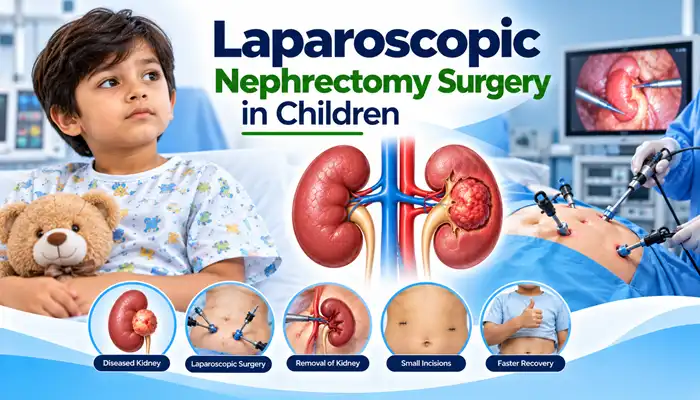
Laparoscopic nephrectomy may be recommended when a kidney has little or no useful function and is associated with significant symptoms or complications.
A child may require evaluation for surgery in cases involving:
Not every child with a kidney abnormality needs nephrectomy. Some conditions can be managed through observation, medication, drainage procedures, or reconstructive surgery.
The main goal of nephrectomy is to remove a kidney when retaining it is unlikely to provide sufficient benefit or may continue to cause significant problems.
Depending on the child’s condition, surgery may help to:
Before recommending surgery, the treating team evaluates whether the kidney can be preserved and confirms that the opposite kidney can adequately support the child’s needs.
Laparoscopic nephrectomy is generally performed under general anesthesia. The surgeon uses a camera and specialized instruments to access and remove the affected kidney through small incisions.
The procedure usually involves these steps:
The exact steps depend on the child’s anatomy, the underlying condition, and whether previous surgery or inflammation has affected the area.
A simple nephrectomy involves removing an entire kidney that is severely damaged or has little useful function. It may be appropriate for selected benign kidney conditions when removal is necessary.
In selected cases, the kidney and part or all of the ureter may need to be removed. This may be considered when the ureter is also affected by the underlying condition or contributes to recurrent infection or other complications.
In this approach, the surgeon accesses the kidney through the abdominal cavity. It provides a working space that may be suitable for selected children depending on their anatomy and clinical condition.
This approach accesses the kidney through the space behind the abdominal cavity. Its suitability depends on the child’s age, anatomy, previous surgery, and the surgeon’s experience.
Open surgery uses a larger incision to access the kidney. It may be preferred when minimally invasive surgery is unsuitable or when conversion to an open procedure is necessary for safety.
Careful preoperative assessment helps determine whether kidney removal is necessary and which surgical approach is appropriate.
The evaluation may include:
These investigations help the medical team understand whether the affected kidney has useful remaining function and whether a kidney-preserving procedure could be a better option.
Laparoscopic nephrectomy is an established procedure in pediatric urology, but it carries potential risks. Safety depends on the child’s condition, the complexity of surgery, and the experience of the surgical and anesthesia teams.
Possible complications include:
The anesthesia team also monitors the child’s breathing, circulation, fluid balance, and other physiological responses during laparoscopy.
When minimally invasive surgery is appropriate, potential benefits include:
These benefits vary according to the child’s age, anatomy, and surgical complexity. Laparoscopic surgery is not necessarily the best approach for every child.
Recovery depends on the child’s age, overall health, surgical findings, and postoperative progress.
After surgery, the child may experience temporary soreness around the incisions, tiredness, or abdominal and shoulder discomfort associated with the gas used during laparoscopy.
General recovery guidance may include:
Children can gradually return to school, sports, and normal activities according to their healing and the surgeon’s recommendations.
Many children can lead active lives with one healthy, functioning kidney. However, long-term follow-up is important to monitor the remaining kidney and overall health.
Depending on the child’s condition, follow-up may include:
The follow-up plan depends on the child’s diagnosis, kidney function, and any additional urinary tract conditions.
Follow-up appointments help assess wound healing, recovery, and the function of the remaining kidney.
Parents should:
A major reduction in urine output, severe pain, significant bleeding, or difficulty breathing requires prompt medical evaluation.
The cost of laparoscopic nephrectomy surgery in Lucknow depends on several factors, including:
A straightforward nephrectomy may involve different costs from a complex procedure requiring additional urinary tract surgery. Parents should obtain an individualized estimate after consultation and review of the child’s investigations.
It is a minimally invasive operation to remove a kidney using a camera and specialized instruments inserted through small incisions.
Nephrectomy may be considered when a kidney is severely damaged, has negligible function, or causes significant complications such as recurrent infections or persistent pain.
Laparoscopic surgery may offer smaller incisions, less postoperative discomfort, and a shorter recovery period in suitable cases. Open surgery may be preferable when the anatomy or clinical circumstances make a minimally invasive approach unsuitable.
Many children can live active lives with one healthy kidney. Regular follow-up may be recommended to monitor blood pressure, kidney function, and the health of the remaining kidney.
Recovery varies according to the child’s condition and the complexity of the operation. The treating team will advise when the child can return to school, sports, and other activities.
Yes. Follow-up may include blood pressure measurements, kidney function tests, urine tests, and imaging when indicated.
No. The suitability of laparoscopic surgery depends on the child’s anatomy, the size and condition of the kidney, previous operations, and the surgeon’s assessment.
Parents should seek an evaluation if their child has a diagnosed kidney abnormality, recurrent urinary tract infections, persistent flank pain, or investigations showing severely reduced kidney function.
Dr. Muni Varma offers Laparoscopic Nephrectomy Surgery in Children in Lucknow, India. With more than 10 years of experience, he uses a careful and child-focused approach to provide appropriate evaluation, surgical planning, and follow-up care. He helps parents understand the surgical approach, available treatment options, and expected recovery for children requiring nephrectomy.
