Choledochal Cysts are rare congenital abnormalities in which the bile ducts become abnormally widened or swollen. The bile ducts are tubes that carry bile from the liver to the gallbladder and small intestine, where it helps digest fats.
In children with choledochal cysts, bile cannot flow normally, leading to bile stasis, inflammation, infection, and damage to the liver or pancreas. If left untreated, these cysts can cause serious complications, including recurrent infections, pancreatitis, liver disease, and an increased risk of bile duct cancer later in life.
Choledochal cysts are usually diagnosed during infancy or early childhood, although some children may remain symptom-free for years. Early diagnosis and surgical removal offer the best long-term outcomes.
The symptoms of choledochal cysts vary depending on the size of the cyst and the child’s age.
Common symptoms of choledochal cysts in children include:
Some children may not develop symptoms until later in childhood.
Choledochal cysts are congenital conditions that develop before birth.
Common causes and contributing factors include:
The exact cause is still not completely understood.
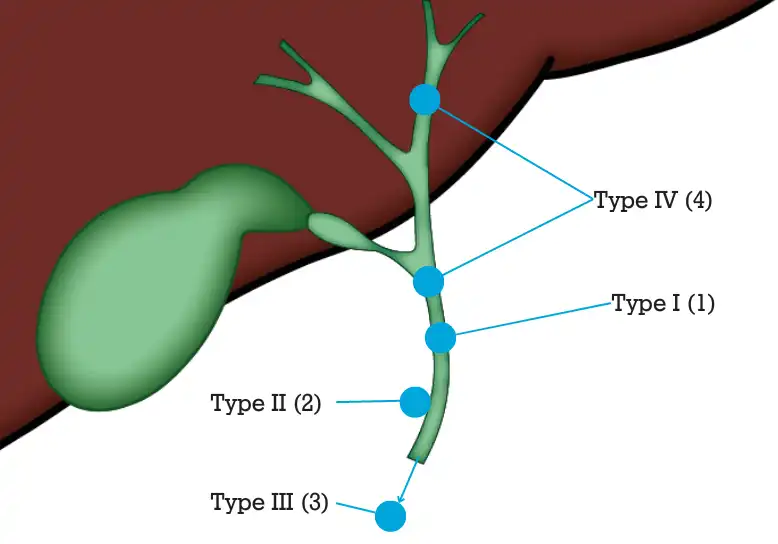
Choledochal cysts are classified using the Todani classification.
The most common type, involving dilation of the common bile duct.
A small pouch or diverticulum develops from the common bile duct.
The cyst develops inside the wall of the duodenum where the bile duct enters the intestine.
Multiple cysts affect both the bile ducts inside and outside the liver.
The cysts affect only the bile ducts within the liver.
Type I choledochal cysts account for the majority of cases in children.
Certain factors may increase the risk of choledochal cysts.
Risk factors include:
Most children with choledochal cysts do not have identifiable risk factors.
If left untreated, choledochal cysts can lead to serious complications.
Bacterial infection of the bile ducts causes fever, abdominal pain, and jaundice.
Inflammation of the pancreas due to blockage of pancreatic secretions.
Long-standing bile obstruction may cause liver fibrosis or cirrhosis.
Bile stasis increases the risk of gallstone formation.
Rarely, the cyst may rupture and leak bile into the abdominal cavity.
Untreated choledochal cysts significantly increase the lifetime risk of cholangiocarcinoma.
Doctors use several imaging tests to diagnose choledochal cysts and assess the biliary system.
Diagnosis may include:
MRCP is considered one of the best non-invasive tests for evaluating choledochal cysts.
Surgical removal is the standard treatment for choledochal cysts.
Children with infection or inflammation may require:
The entire abnormal bile duct is removed to prevent future complications.
After removing the cyst, surgeons reconnect the liver bile ducts to the small intestine using a Roux-en-Y hepaticojejunostomy. This allows bile to flow normally into the intestine.
Many children can undergo laparoscopic choledochal cyst excision, which offers:
Most children recover well after successful surgery.
Parents are usually advised to:
Regular follow-up helps monitor liver function and long-term recovery.
Helpful care measures include:
Long-term follow-up is important to ensure healthy liver and bile duct function.
Parents should seek medical attention if the child develops:
Early evaluation helps prevent serious liver and biliary complications.
Yes, choledochal cysts are congenital abnormalities that develop during fetal growth.
Some cases can be identified during prenatal ultrasound, while others are diagnosed after birth.
Yes, complete surgical removal is recommended because untreated cysts can cause serious complications and increase the risk of bile duct cancer.
It is a reconstructive procedure performed after cyst removal to restore the normal flow of bile from the liver into the small intestine.
Yes, most children recover well and lead healthy, active lives with proper treatment and follow-up.
Recurrence is uncommon after complete cyst removal, but regular follow-up is important to monitor long-term liver and biliary health.
Dr. Muni Varma is an experienced Pediatric Surgeon specializing in the diagnosis and treatment of choledochal cysts and other complex hepatobiliary disorders in children. With expertise in pediatric laparoscopic surgery, biliary reconstruction, neonatal surgery, and advanced gastrointestinal procedures, Dr. Varma provides comprehensive child-focused care using modern diagnostic and surgical techniques. From accurate diagnosis and complete cyst excision to Roux-en-Y hepaticojejunostomy and long-term follow-up, he focuses on protecting liver function, preventing complications, and ensuring healthy growth and recovery. Early expert surgical treatment offers excellent long-term outcomes and helps children lead healthy lives.