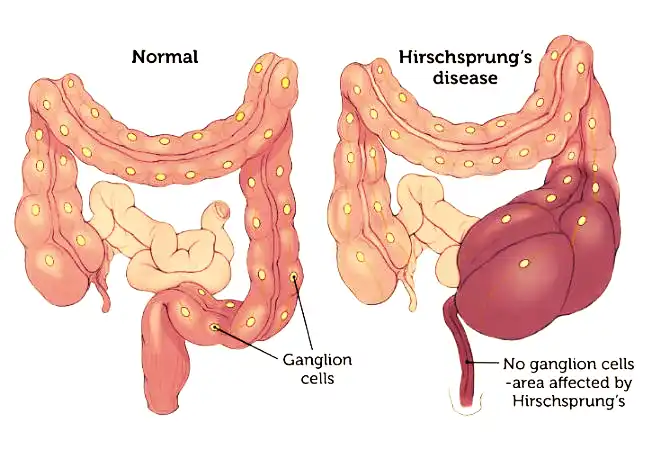
Hirschsprung Disease is a congenital condition in which nerve cells (ganglion cells) are absent in a part of the large intestine (colon). These nerve cells are responsible for helping the intestines move stool normally. Without them, the affected portion of the bowel cannot relax properly, causing stool to become trapped and leading to intestinal blockage.
Hirschsprung disease is usually diagnosed in newborns and infants, although mild cases may not be detected until later in childhood. It is one of the most common causes of intestinal obstruction in newborn babies.
Early diagnosis and timely surgical treatment help restore normal bowel function and prevent serious complications.
The symptoms of Hirschsprung disease depend on the length of the affected bowel and the child’s age.
Common symptoms of Hirschsprung disease in children include:
Older children may have lifelong constipation that does not improve with regular medications.
Hirschsprung disease develops before birth when nerve cells fail to develop normally in a portion of the intestine.
Common causes and contributing factors include:
The exact reason why these nerve cells fail to develop is not always known.
The types of Hirschsprung disease are based on the length of the intestine affected.
This is the most common type. Only the lower part of the large intestine is affected.
A larger portion of the colon lacks nerve cells.
The entire large intestine is affected.
A very rare and severe form in which both the large intestine and part of the small intestine lack nerve cells.
Certain factors increase the risk of Hirschsprung disease.
Risk factors include:
The condition is more common in boys than in girls.
Without treatment, Hirschsprung disease can lead to serious complications.
A severe intestinal infection that can become life-threatening if not treated promptly.
The bowel becomes blocked due to trapped stool.
Chronic stool retention may worsen over time.
Pressure inside the intestine may cause it to rupture.
Poor bowel function can affect nutrient absorption and growth.
Children may have poor weight gain and delayed physical development.
Doctors use several tests to confirm Hirschsprung disease.
Diagnosis may include:
A rectal biopsy is considered the gold standard for confirming Hirschsprung disease because it shows the absence of ganglion cells.
Treatment involves removing the affected portion of the intestine that lacks nerve cells.
Before surgery, some children may require:
This is the standard treatment for Hirschsprung disease.
During the procedure:
Common pull-through procedures include:
Some children with severe intestinal obstruction or enterocolitis may require a temporary colostomy before definitive surgery.
Most children recover well after surgery.
Parents are usually advised to:
Some children may experience temporary constipation or loose stools during recovery.
Helpful care measures include:
Long-term follow-up helps monitor bowel function and growth.
Parents should seek immediate medical attention if the child develops:
These symptoms may indicate Hirschsprung-associated enterocolitis, which requires urgent treatment.
Yes, Hirschsprung disease is a congenital condition that develops before birth.
Yes. Surgery is highly effective, and most children achieve good bowel function after treatment.
A rectal biopsy is the gold standard because it confirms the absence of nerve cells in the affected bowel.
Yes, surgical removal of the affected bowel is the definitive treatment.
It is a serious infection of the intestine that can occur before or after surgery and requires immediate medical attention.
Yes. Most children grow normally and lead healthy, active lives after successful surgery, although some may require ongoing bowel management and follow-up.
Dr. Muni Varma is an experienced Pediatric Surgeon specializing in the diagnosis and treatment of Hirschsprung disease and other complex pediatric colorectal disorders. With expertise in neonatal surgery, minimally invasive pediatric surgery, pull-through procedures, and bowel reconstruction, Dr. Varma provides comprehensive child-focused care using advanced diagnostic and surgical techniques. From early diagnosis and emergency management to definitive surgery and long-term bowel care, he focuses on restoring normal bowel function, preventing complications, and supporting healthy growth and development. Early expert treatment and dedicated follow-up help children achieve excellent long-term outcomes and an improved quality of life.