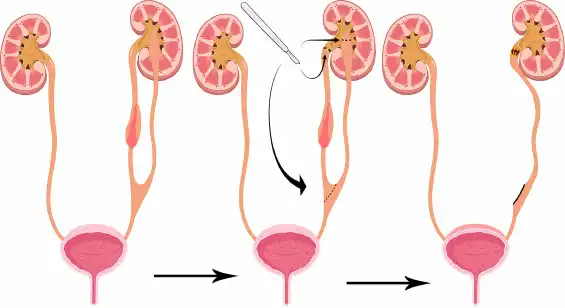
Renal Duplication in children is a congenital urinary tract condition in which a child is born with two ureters draining a single kidney instead of one. The ureter is the tube that carries urine from the kidney to the bladder.
This condition is also called Duplex Kidney or Duplicated Collecting System. It may affect one kidney or both kidneys. In some children, both ureters drain separately into the bladder, while in others they may join together before entering the bladder.
Many children with renal duplication may not show symptoms, and the condition is sometimes discovered accidentally during an ultrasound. However, some children may develop urinary infections, urine blockage, reflux, or kidney swelling.
Early diagnosis and proper treatment help prevent urinary complications and protect kidney function.
Some children with renal duplication may not have any symptoms.
Common symptoms of renal duplication in children include:
Symptoms usually appear when associated urinary problems develop.
Renal duplication develops during fetal growth before birth.
The condition occurs when two ureteric buds form instead of one during the development of the urinary system.
Common causes and contributing factors include:
Most cases occur naturally without a specific known cause.
Certain factors may increase the risk of renal duplication.
Risk factors include:
The condition is more commonly seen in girls.
If associated urinary problems develop, renal duplication may lead to complications.
Abnormal urine drainage may increase infection risk.
Urine may flow backward from the bladder toward the kidneys.
Blocked urine flow may cause swelling of the kidneys.
Some children with duplicated systems may develop a ureterocele.
Repeated infections or obstruction may affect kidney function over time.
Some children may experience continuous urine leakage.
Doctors use several tests to diagnose renal duplication and evaluate kidney function.
Diagnosis may include:
These tests help identify associated reflux, obstruction, or kidney damage.
Treatment depends on symptoms and associated urinary complications.
Children without symptoms may only require regular monitoring.
Children with recurrent urinary infections may need antibiotics.
Surgery may be needed if the urine flow is blocked.
This procedure corrects abnormal ureter drainage into the bladder.
In severe cases with poorly functioning kidney tissue, damaged kidney segments may be removed.
Conditions such as ureterocele or reflux may require additional treatment.
Most children recover well after proper treatment.
Parents are usually advised to:
Regular follow-up helps protect long-term kidney health.
Helpful care measures include:
Early treatment and regular monitoring improve long-term outcomes.
Parents should seek medical advice if the child develops:
Early diagnosis of renal duplication in children helps prevent kidney complications.
Many children have mild cases without major problems, but some may develop urinary complications.
Yes, severe reflux or obstruction may gradually affect kidney health.
No, many children only require monitoring and regular follow-up.
Yes, many cases are identified during a pregnancy ultrasound.
It is one of the more common congenital urinary tract abnormalities.
Yes, with proper treatment and follow-up, most children live healthy, normal lives.
Dr. Muni Varma is an experienced Pediatric Surgeon and Pediatric Urologist providing advanced diagnosis and treatment for renal duplication and other congenital urinary tract abnormalities in children. With expertise in managing duplex kidneys, vesicoureteral reflux, hydronephrosis, and pediatric reconstructive urology, Dr. Muni Varma offers child-focused care using modern diagnostic and minimally invasive surgical techniques. From careful monitoring to advanced corrective procedures, he focuses on protecting kidney function, improving urinary drainage, and preventing long-term complications. Early expert care and regular follow-up help children achieve healthy urinary development and better long-term outcomes.