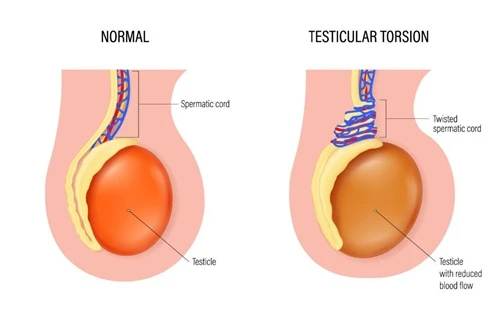
Testicular torsion in children is a medical emergency that occurs when the spermatic cord twists, cutting off the blood supply to the testicle. Without prompt treatment, the affected testicle can suffer permanent damage due to lack of oxygen and nutrients.
Testicular torsion can occur at any age but is most common in newborns and boys between 12 and 18 years. It may happen suddenly during sleep, physical activity, or without any obvious cause. Early diagnosis and emergency surgery within 4–6 hours of symptom onset offer the best chance of saving the testicle.
Parents should seek immediate medical attention if a child experiences sudden severe scrotal pain or swelling.
Symptoms usually develop suddenly and become severe within a short period.
Common symptoms of testicular torsion in children include:
In newborns, testicular torsion may present as a painless swollen, firm, or discolored scrotum.
Testicular torsion occurs when the spermatic cord twists, preventing normal blood flow to the testicle.
Common causes and contributing factors include:
In many children, testicular torsion occurs without any obvious trigger.
This is the most common type in older children and adolescents. The testicle twists within the tunica vaginalis due to inadequate fixation.
This type usually occurs in newborns before the tissues surrounding the testicle become firmly attached.
The spermatic cord twists and untwists on its own, causing episodes of severe pain that resolve spontaneously. Surgical treatment is recommended to prevent complete torsion.
Certain factors increase the risk of testicular torsion.
Risk factors include:
Children with recurrent episodes of testicular pain should be evaluated by a pediatric surgeon or pediatric urologist.
Delayed treatment can lead to serious complications.
Prolonged interruption of blood flow may permanently damage the testicle, requiring surgical removal (orchiectomy).
Loss of one or both testicles may affect fertility later in life.
Even after successful surgery, the affected testicle may shrink due to previous damage.
Untreated tissue damage may increase the risk of infection.
Loss of a testicle can affect a child’s emotional well-being and body image.
Prompt surgery significantly reduces the risk of these complications.
Because testicular torsion is a surgical emergency, diagnosis is based on symptoms, examination, and imaging when appropriate.
Diagnosis may include:
If clinical suspicion is high, emergency surgery should not be delayed while waiting for imaging.
Immediate surgery is the only definitive treatment for testicular torsion.
The surgeon makes a small incision in the scrotum to examine the affected testicle.
During surgery:
If the testicle remains viable, it is permanently stitched to the scrotal wall to prevent recurrence.
If the testicle has lost its blood supply for too long and cannot be saved, it is surgically removed.
Early surgery within 4–6 hours offers the highest chance of preserving the affected testicle, while treatment after 24 hours greatly reduces the likelihood of salvage.
Most children recover well after surgery.
Parents are usually advised to:
Most children can return to school within a few days and resume sports after their surgeon confirms complete healing.
Helpful care measures include:
Good postoperative care supports faster healing and reduces the risk of complications.
Seek emergency medical care immediately if your child develops:
Testicular torsion is a true emergency. Prompt treatment can make the difference between saving and losing the testicle.
Yes. Testicular torsion is a surgical emergency that requires immediate treatment to restore blood flow to the testicle.
Surgery should ideally be performed within 4–6 hours after symptoms begin to maximize the chance of saving the testicle.
Yes. Many children and teenagers develop testicular torsion while sleeping or immediately after waking up.
After successful orchidopexy, recurrence is uncommon because both testicles are usually secured during surgery.
Yes. In most cases, one healthy testicle can produce enough testosterone and sperm for normal puberty and future fertility.
Sudden severe pain, swelling of one side of the scrotum, nausea, vomiting, or a testicle sitting higher than usual are warning signs that require immediate emergency evaluation.
Dr. Muni Varma is an experienced Pediatric Surgeon and Pediatric Urologist specializing in the emergency diagnosis and treatment of testicular torsion and other pediatric urological conditions. With expertise in emergency scrotal exploration, orchidopexy, minimally invasive pediatric surgery, and newborn and adolescent urological care, Dr. Varma provides prompt, evidence-based treatment aimed at preserving testicular function whenever possible. From rapid diagnosis and emergency surgery to postoperative care and long-term follow-up, he focuses on minimizing complications, protecting fertility, and ensuring the best possible outcomes for every child.