Injection sclerotherapy for children is a minimally invasive medical procedure used to treat selected vascular and lymphatic lesions. It involves injecting a specially selected medicine, called a sclerosant, into an abnormal blood vessel or fluid-filled lesion. The medicine causes a controlled reaction within the targeted area, leading to the closure or gradual reduction of the treated lesion.
Sclerotherapy may be recommended for certain venous malformations, lymphatic malformations, and other selected vascular abnormalities. It can help reduce the size of a lesion, relieve associated symptoms, and improve function or appearance in appropriately selected cases.
The procedure differs from surgery because it generally does not require a large incision to remove the lesion. Depending on its location and complexity, sclerotherapy may be performed under imaging guidance, sometimes with general anesthesia in children.
Dr. Muni Varma offers pediatric surgical consultation in Lucknow for children requiring evaluation of vascular and lymphatic lesions and discussion of suitable treatment options. The decision to perform injection sclerotherapy depends on the diagnosis, lesion characteristics, symptoms, and the child’s overall health.
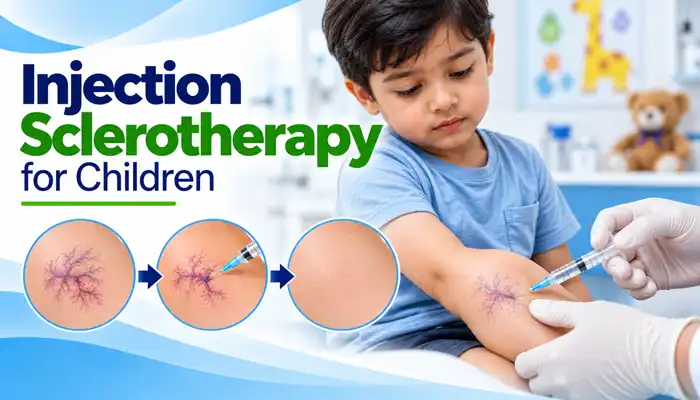
Not every vascular or lymphatic lesion requires treatment. Some lesions can be monitored, while others may need intervention because of pain, swelling, functional problems, or complications.
Injection sclerotherapy may be considered when a child has:
The suitability of sclerotherapy depends on the type of lesion. It is not the standard treatment for every haemangioma or vascular abnormality, and the diagnosis should be confirmed before treatment is planned.
The primary goal of injection sclerotherapy is to reduce or control an abnormal vascular or lymphatic lesion without requiring extensive surgical removal.
Depending on the condition, treatment may help to:
The degree of improvement varies according to the lesion’s type, size, location, and response to the sclerosant. Multiple treatment sessions may be necessary.
Injection sclerotherapy is planned according to the location and characteristics of the lesion. Imaging guidance is often used to help the treating team identify the target and deliver the sclerosant appropriately.
The procedure generally involves the following steps:
The exact technique, injection agent, and number of sessions depend on the individual lesion and the treating specialist’s assessment.
Venous malformations are abnormalities of veins that may be present from birth. They can appear as soft, bluish swellings and may cause pain, enlargement, or discomfort.
Sclerotherapy may help reduce the size of selected venous malformations by treating the abnormal venous spaces. The suitability of treatment depends on the lesion’s blood flow, location, and relationship to surrounding structures.
Lymphatic malformations develop from abnormal lymphatic vessels and may contain fluid-filled spaces. They can occur in the neck, face, armpit, trunk, or other parts of the body.
Sclerotherapy may be considered for selected lymphatic malformations, particularly those with cystic spaces that can be accessed for treatment. Some children require repeated sessions or a combination of different treatments.
Certain other vascular abnormalities may be considered for sclerotherapy after specialist assessment. Treatment depends on the specific diagnosis and whether the lesion’s structure and blood flow make the procedure appropriate.
Not all vascular lesions respond to sclerotherapy. Some require observation, medication, laser treatment, surgery, or a combination of approaches.
Careful planning helps determine whether the procedure is appropriate and how to minimize risks.
Before treatment, the medical team may assess:
For complex lesions, treatment may involve a multidisciplinary team that includes pediatric surgeons, interventional radiologists, anesthesiologists, and other specialists as needed.
Injection sclerotherapy is an established treatment for selected vascular and lymphatic malformations. However, its safety depends on the lesion’s location, the sclerosant used, the injection technique, and the child’s clinical condition.
Potential complications include:
Some lesions lie close to important nerves, airways, blood vessels, or other organs. These cases require particularly careful planning.
The treating specialist should explain the specific risks, expected benefits, available alternatives, and possibility of repeat treatment before the procedure.
When appropriate for the diagnosis, injection sclerotherapy may offer several benefits:
Results vary, and complete disappearance of the lesion cannot be guaranteed. Some children may require additional procedures or other forms of treatment.
Recovery depends on the lesion’s size and location, the sclerosant used, and the extent of treatment. Temporary swelling, tenderness, bruising, or discomfort may occur after the procedure.
Parents should follow the treatment team’s instructions, which may include:
Some swelling after treatment may be expected, but parents should know what degree of swelling is normal for their child’s specific procedure.
Severe or increasing pain, skin darkening, blistering, fever, rapidly increasing swelling, or new functional problems require prompt medical assessment. Breathing difficulty or rapidly increasing swelling around the neck warrants emergency attention.
The number of sessions varies according to the type, size, and complexity of the lesion and how it responds to treatment.
Some lesions improve after one session, while others require multiple procedures over time. The treating specialist evaluates the response after each session before deciding whether additional treatment is necessary.
The goal is to achieve meaningful improvement while minimizing the risk of damage to surrounding tissues.
Follow-up is important for assessing the treatment response and detecting complications early.
During follow-up, the medical team may evaluate:
Parents should report any unexpected symptoms and attend follow-up visits according to the treatment plan.
Injection sclerotherapy and surgery are different treatment approaches, and the choice depends on the type of lesion.
Injection sclerotherapy uses a sclerosant to treat the targeted abnormal vessels or cystic spaces. It may be suitable for selected venous and lymphatic malformations.
Surgery involves removing or reconstructing affected tissue. It may be appropriate for selected localized lesions, complications, or cases where surgical removal offers a better outcome.
Some children benefit from a combination of sclerotherapy and surgery. The treating team determines the approach based on the lesion’s anatomy, symptoms, risks, and expected response.
The cost of injection sclerotherapy in Lucknow depends on several factors, including:
A small, accessible lesion may require a different level of care from a complex malformation near important structures. Parents should request an individualized estimate after clinical evaluation.
Injection sclerotherapy is a minimally invasive procedure in which a sclerosant is injected into selected abnormal blood vessels or fluid-filled lesions to help reduce or close the treated area.
It is commonly used for selected venous malformations and lymphatic malformations. The appropriate treatment depends on the diagnosis, location, and characteristics of the lesion.
Some discomfort may occur during or after treatment. The anesthesia and pain-management plan depends on the child’s age, the lesion’s location, and the procedure being performed.
No. Some lesions can be monitored, while others may require medication, surgery, laser treatment, or a combination of approaches. Treatment is recommended according to the child’s individual condition.
Some lesions respond to a single session, while others require multiple treatments. The number of sessions depends on the lesion’s type, size, and response.
A lesion may persist, partially respond, or recur after treatment. Additional sessions or another treatment approach may be needed, depending on the condition.
Neither treatment is universally safer for every lesion. Sclerotherapy may avoid extensive surgery in suitable cases, but it carries its own risks. The best approach depends on the lesion’s anatomy and the child’s clinical needs.
Parents should seek evaluation if a child has a vascular or lymphatic swelling that grows, causes pain, affects movement, or repeatedly becomes inflamed. Rapid enlargement, skin breakdown, or swelling that affects breathing or swallowing requires prompt assessment.
Dr. Muni Varma offers Injection Sclerotherapy for Children in Lucknow, India. With more than 10 years of experience, he uses a careful and child-focused approach to provide appropriate evaluation, treatment planning, and follow-up care. He helps parents understand the available treatment options, procedural considerations, and expected recovery for children requiring evaluation of vascular or lymphatic lesions.
