Pediatric Cervical Esophagostomy Surgery is a surgical procedure in which the cervical esophagus is brought to an opening in the neck to allow saliva and esophageal secretions to drain outside the body. It is generally considered a staged or temporary procedure for selected children when the normal passage of secretions through the esophagus into the stomach cannot be safely maintained.
The procedure may be considered in complex cases involving severe esophageal abnormalities, disruption of the esophagus, or situations in which the esophagus cannot be immediately reconstructed. The opening created in the neck is called a cervical esophagostomy and is sometimes referred to as a spit fistula.
Cervical esophagostomy is different from a gastrostomy. A gastrostomy provides access directly into the stomach for feeding, whereas a cervical esophagostomy allows saliva and secretions from the upper esophagus to drain externally. A separate feeding route, such as a gastrostomy or another prescribed method, may be needed to provide nutrition.
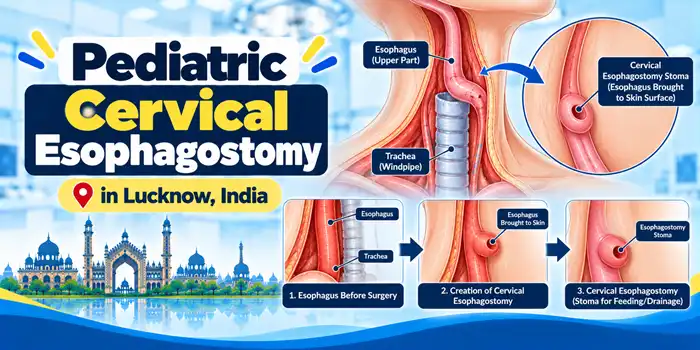
Cervical esophagostomy may be considered when normal esophageal continuity cannot be safely maintained and external drainage of saliva is needed.
Possible indications include:
The procedure is not required for every child with esophageal atresia or esophageal injury. The pediatric surgical team determines whether diversion is necessary based on the child’s anatomy, condition, and reconstructive options.
The primary goal is to divert saliva and secretions from the upper esophagus when they cannot safely pass into the stomach.
Depending on the child’s condition, the procedure may help to:
Cervical esophagostomy does not restore normal swallowing or connect the esophagus to the stomach. Additional treatment may be required to reconstruct the food passage.
The operation is performed under general anesthesia.
The surgeon makes an incision in the neck and carefully identifies the cervical esophagus and nearby structures. The upper esophagus is brought to the skin through a planned opening and secured to create an external drainage site.
The general steps include:
The exact technique depends on the child’s anatomy, the reason for diversion, and the planned future treatment.
Cervical esophagostomy is usually an open surgical procedure because the surgeon needs to access and bring the esophagus to the neck skin.
The precise location and configuration of the opening depend on the child’s anatomy and the surgical plan. It is not a single standardized technique for every clinical situation.
A temporary cervical esophagostomy may be created when the child requires esophageal diversion before definitive reconstruction.
During this period, saliva drains through the neck opening. Nutrition is provided through a separate feeding route selected by the treating team.
The opening may later be closed or incorporated into a reconstructive procedure when the child is suitable for further surgery.
In selected complex cases, cervical esophagostomy is one stage in a broader treatment plan.
The team first addresses the child’s immediate needs, including secretion management and nutrition. Once the child is stable and the surgical team has determined the appropriate reconstructive option, further surgery may be considered.
The timing and type of reconstruction depend on the underlying esophageal problem and the child’s clinical condition.
Cervical esophagostomy does not provide a route for food to enter the stomach. Therefore, children who cannot safely swallow or whose esophagus is not connected to the stomach need a separate nutrition plan.
Depending on the child’s circumstances, nutrition may be provided through:
The pediatric surgical and nutrition teams determine the appropriate feeding method, formula, and schedule. Parents should not attempt oral feeding unless the treating team confirms that it is safe.
The timing depends on the reason for esophageal diversion and the child’s overall condition.
In urgent situations, diversion may be considered when secretions cannot be safely managed or when the esophagus cannot be reconstructed immediately. In other cases, the procedure may be planned as part of staged treatment.
The team considers the child’s breathing, nutritional status, anatomy, infection risk, and potential for future reconstruction before deciding when to proceed.
Cervical esophagostomy is an established surgical option for selected complex esophageal conditions, but it carries risks.
The neck contains important structures, including the airway, blood vessels, and nerves. The surgical team plans the procedure carefully to minimize injury and ensure that the opening drains appropriately.
Risk depends on the child’s age, underlying condition, previous surgery, and overall health. Anesthesia assessment, postoperative monitoring, and appropriate nutritional support are important parts of care.
Potential benefits include:
The benefits depend on the child’s diagnosis and the overall treatment strategy.
Possible complications include:
The team provides instructions on managing the opening and identifies warning signs that require medical assessment.
Recovery depends on the child’s medical condition and whether other procedures are performed at the same time.
After surgery, the team monitors the neck wound, drainage, pain, breathing, and feeding plan.
Recovery may include:
Children with complex esophageal abnormalities may require a longer hospital stay and coordinated specialist care.
Parents and caregivers should follow the surgical team’s instructions carefully.
Important measures include:
Urgent medical assessment is required for breathing difficulty, significant bleeding, fever with worsening illness, rapidly increasing neck swelling, or sudden inability of secretions to drain.
Regular follow-up helps the team monitor the opening, nutrition, and readiness for further treatment.
The surgical team may assess:
The follow-up plan is individualized according to the underlying condition and the intended treatment pathway.
In selected children, a cervical esophagostomy is temporary and may later be closed or incorporated into a reconstructive operation.
However, reversal is not automatic. The surgical team must determine whether the esophagus can be reconnected safely or whether another form of esophageal replacement is needed.
The decision depends on the original condition, the available esophageal tissue, previous procedures, and the child’s overall health.
The long-term outlook depends primarily on the underlying esophageal condition and the possibility of reconstruction.
Some children proceed to further surgery to restore continuity of the digestive tract. Others may require a more complex, individualized plan involving long-term nutritional support and specialist follow-up.
Growth, nutrition, respiratory health, and management of secretions remain important parts of ongoing care.
The cost varies according to the complexity of the procedure and the child’s medical needs.
Factors that may affect the total cost include:
Parents should request an individualized estimate from the hospital after the treatment plan has been established.
Before the procedure, parents should understand why diversion is needed and what the planned treatment pathway involves.
Useful questions to discuss with the surgical team include:
It is a procedure in which the upper esophagus is brought to an opening in the neck so that saliva and esophageal secretions can drain externally.
It may be considered in selected complex esophageal conditions when secretions need to be diverted and immediate reconstruction is not appropriate.
No. Cervical esophagostomy provides an external drainage route for upper esophageal secretions. Gastrostomy creates access directly into the stomach, usually for feeding.
Not necessarily. If the esophagus is not connected to the stomach, food cannot pass normally through it. The child needs an individualized feeding plan, and oral feeding should occur only when the treating team confirms it is safe.
It may be temporary in selected cases, but whether it can be reversed depends on the underlying condition and available reconstructive options.
Possible complications include infection, skin irritation, narrowing of the opening, leakage, retraction, and the need for further surgery.
Some children require later surgery to reconstruct the esophagus or restore digestive tract continuity. The need for further procedures depends on the child’s diagnosis and treatment plan.
Dr. Muni Varma offers Pediatric Cervical Esophagostomy Surgery for children in Lucknow, India. With more than 10 years of experience, he uses a careful and child-focused approach to provide appropriate evaluation, surgical planning, and follow-up care. He helps parents understand complex pediatric esophageal conditions, secretion management, nutritional support, and potential reconstructive options.
