Pediatric Circumcision Surgery is a procedure in which the foreskin covering the head of the penis is removed. Circumcision may be performed for medical reasons when a child has certain foreskin problems, or it may be considered for personal, cultural or religious reasons.
In children, the need for circumcision should be assessed individually. Some foreskin conditions can be managed without surgery, while others may require circumcision when symptoms continue or other treatments have not worked.
Dr. Muni Varma evaluates each child carefully and discusses the appropriate treatment options with parents before recommending surgery.
Circumcision is a surgical procedure that removes the foreskin, the fold of skin that covers the glans (head) of the penis.
The procedure is performed in different ways depending on the child’s age, medical condition and the surgeon’s preferred technique.
When circumcision is being considered for a medical reason, the underlying condition and available alternatives should be evaluated before surgery.
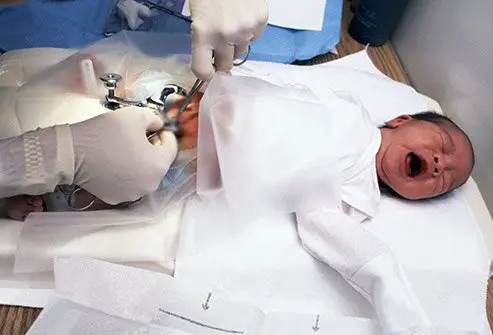
Circumcision may be recommended for selected medical conditions affecting the foreskin.
Possible reasons include:
Circumcision may also be performed for non-medical reasons, depending on the family’s preferences and circumstances.
Phimosis occurs when the foreskin cannot be pulled back over the head of the penis.
It is important to understand that not being able to retract the foreskin is normal in many young boys. The foreskin naturally becomes more mobile as children grow.
Therefore, parents should not forcefully pull back a young child’s foreskin.
Surgery is generally considered only when there is a medical reason, such as significant scarring, recurrent problems or persistent pathological phimosis.
Not every child with a tight or non-retractable foreskin needs circumcision.
A pediatric surgeon may consider surgery when the child has:
The decision depends on the child’s symptoms, age and examination findings.
Phimosis can be physiological or pathological.
Physiological phimosis is common in young children and often improves naturally as the child grows. It does not automatically require circumcision.
Pathological phimosis occurs when scarring or another abnormality causes persistent tightening of the foreskin.
Depending on the individual case, treatment may include medical management or a surgical procedure. Circumcision is one of the surgical options when it is medically appropriate.
Before surgery, the child is examined and the reason for circumcision is confirmed.
During the procedure, the foreskin is carefully separated from the glans and removed. The remaining skin is then positioned appropriately and the incision is closed.
Dissolvable stitches may be used so that they do not usually need to be removed separately.
The exact technique depends on the child’s age, anatomy and reason for surgery.
Yes. Circumcision in children is performed using appropriate anesthesia so that the child does not experience pain during the procedure.
The anesthesia plan depends on the child’s age, health and the type of procedure.
Parents can discuss anesthesia and pain management with the treating pediatric surgeon before surgery.
Circumcision is a commonly performed surgical procedure, but complications are possible with any operation.
Potential complications may include:
The risk depends on the child’s age, medical condition and surgical circumstances.
Most children recover well after circumcision.
Parents may be advised to:
Mild swelling and discomfort can occur during the early recovery period.
Parents should seek medical advice if there is significant bleeding, increasing swelling, fever, severe pain, pus or difficulty passing urine.
Healing varies depending on the child’s age and the surgical technique.
The penis may appear swollen or slightly different during the early healing period. The appearance generally settles as healing progresses.
The pediatric surgeon will advise parents about bathing, physical activity and when the child can return to normal activities.
No, When phimosis is physiological and does not cause problems, treatment may not be required.
For certain cases of pathological phimosis, topical medication and gentle stretching may be considered before surgery. If the condition does not improve or significant scarring is present, circumcision or another appropriate surgical procedure may be discussed.
Treatment should be based on the child’s examination rather than attempting forceful foreskin retraction at home.
Parents should not forcefully retract the foreskin.
In young boys, the foreskin may naturally remain attached to the glans and may not retract fully. Forceful pulling can cause pain, small tears and scarring, which may make foreskin problems worse.
Gentle hygiene and following the pediatric surgeon’s advice are generally more appropriate.
Pediatric circumcision is a surgical procedure that removes the foreskin covering the head of the penis.
No. Circumcision is not required for every child. It may be recommended for selected medical conditions or performed for personal, cultural or religious reasons.
No. Normal non-retractability of the foreskin is common in young boys and often improves naturally. Circumcision may be considered when there is pathological phimosis or persistent medical problems.
The procedure is performed under appropriate anesthesia to prevent pain during surgery. Some discomfort can occur during the recovery period and can usually be managed with medicines recommended by the treating doctor.
Yes. Circumcision may be used to treat pathological phimosis when medically appropriate. Other treatment options may also be considered depending on the child’s condition.
The procedure is generally relatively short, but the exact duration depends on the child’s age, anatomy and surgical circumstances.
Healing varies between children. The pediatric surgeon will provide specific instructions about wound care, bathing and returning to normal activities.
A small amount of bleeding can occur after surgery, but significant or persistent bleeding requires medical evaluation.
Children can generally urinate normally after recovery. Difficulty passing urine after surgery should be reported to the treating medical team.
No. Forceful retraction can cause injury and scarring. Parents should follow appropriate hygiene advice and seek medical evaluation if they are concerned about the foreskin.
Dr. Muni Varma offers advanced Pediatric Circumcision Surgery for Children in Lucknow, India. With more than 10 years of experience, he uses a careful and child-focused approach to provide accurate evaluation, appropriate surgical planning, and better long-term care. He offers personalized treatment and follow-up support for children requiring circumcision, helping parents understand the treatment process and providing quality pediatric surgical care in Lucknow, India.
