A hernia in a child occurs when an internal tissue or part of an organ pushes through a weak area in the surrounding muscle or abdominal wall. In children, hernias are often related to an opening that did not close completely during development before birth. A swelling or bulge may become more noticeable when the child cries, coughs, strains or becomes active.
Pediatric Hernia Surgery is performed to repair the opening and prevent the hernia from causing complications. Dr. Muni Varma evaluates each child individually and recommends the appropriate surgical approach based on the type and location of the hernia, the child’s age and overall health.
A hernia develops when tissue pushes through a weak area in the muscle or tissue that normally holds it in place.
In children, the most common type is an inguinal hernia, which appears in the groin and may extend towards the scrotum in boys or the labia in girls.
Other types of hernias can also occur, including:
The symptoms and treatment can vary depending on the type of hernia.
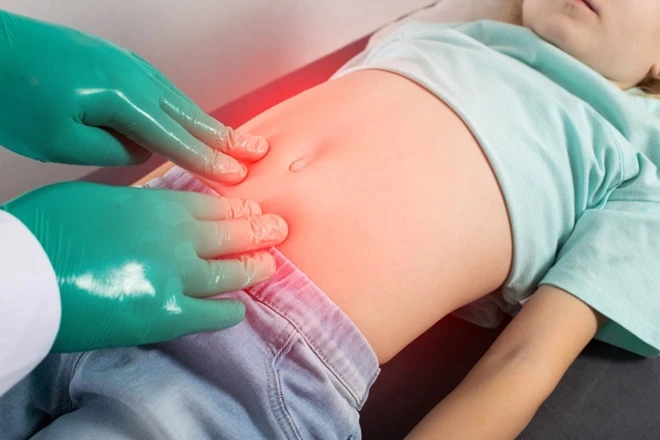
Many pediatric hernias are related to the way the abdominal wall develops before birth.
For example, an inguinal hernia can occur when a passage called the processus vaginalis does not close properly. This can leave an opening through which abdominal contents can move into the groin.
Umbilical hernias occur around the belly button when the opening in the abdominal wall does not close completely.
A child does not necessarily develop a hernia because of lifting, playing or normal physical activity.
The most noticeable sign is usually a swelling or bulge.
Parents may notice that:
Some children may not experience pain, particularly when the hernia is uncomplicated.
The need for surgery depends on the type of hernia.
An inguinal hernia in a child generally does not close on its own and is usually treated surgically after diagnosis. This is because an intestinal loop or other tissue can become trapped inside the hernia.
Umbilical hernias are different. Many small umbilical hernias close naturally during early childhood, so immediate surgery is not always necessary.
The pediatric surgeon considers the child’s age, symptoms, size and type of hernia before recommending treatment.
The surgical technique depends on the type of hernia.
For an inguinal hernia, the surgeon identifies the abnormal opening and carefully separates the hernia sac from nearby structures. The opening is then closed to prevent abdominal contents from passing through it again.
In children, the repair generally focuses on closing the underlying opening rather than reinforcing the abdominal wall with mesh, as is commonly done in many adult hernia repairs.
The exact technique depends on the child’s condition.
Open surgery is a commonly used approach for pediatric inguinal hernia.
A small incision is made in the groin area to access the hernia. The surgeon identifies and deals with the hernia sac and closes the abnormal opening.
The incision is then closed carefully.
Laparoscopic surgery uses a small camera and specialized instruments introduced through small incisions.
Depending on the type of hernia and the child’s individual circumstances, a laparoscopic approach may allow the surgeon to assess the affected side and, in selected cases, identify a hernia on the opposite side.
The choice between open and laparoscopic surgery is made after considering the child’s age, hernia type, clinical findings and surgical requirements.
Pediatric hernia repair is a commonly performed procedure, but every surgery has potential risks.
Possible complications may include:
The risk varies according to the child’s age, general health and type of hernia.
Sometimes, the contents of a hernia can become trapped and cannot move back into the abdomen. This is called an incarcerated hernia.
If the blood supply to the trapped tissue becomes compromised, it is called a strangulated hernia and requires urgent medical attention.
Parents should seek immediate medical care if a child with a known hernia develops:
These symptoms should not be ignored.
Most children recover well after hernia repair.
Parents may receive instructions regarding:
Young children often return to their normal routine relatively quickly, but the exact recovery period depends on the child’s age and the type of surgery performed.
Hernia recurrence after repair is possible but uncommon.
The risk can depend on the type and complexity of the hernia, the child’s underlying condition and other factors.
Regular follow-up allows the surgeon to assess healing and address any concerns.
Hernias can occur in newborns and infants, particularly inguinal hernias.
In premature babies, inguinal hernias are relatively common because the abdominal structures may not have completed their normal development.
The timing of surgery in babies is determined according to the child’s age, health, hernia characteristics and risk of complications.
In boys, an inguinal hernia may extend into the scrotum. The surgeon takes particular care to protect the testis and surrounding structures during repair.
If an inguinal hernia is associated with an undescended testis or another pediatric urological condition, the treatment plan may need to take both conditions into consideration.
Girls can also develop inguinal hernias. In some cases, abdominal structures such as an ovary may be present within the hernia sac.
For this reason, a groin swelling in a girl should be evaluated by a pediatric surgeon rather than being ignored.
A pediatric hernia is a weakness or opening in the abdominal wall through which tissue or an organ can protrude.
Inguinal hernia is the most common type of hernia in children.
An inguinal hernia generally does not close on its own and is usually treated surgically after diagnosis.
No. Many umbilical hernias in children close naturally as the child grows. The need for surgery depends on factors such as the size of the opening, symptoms and the child’s age.
Yes. Hernia repair in children is performed under appropriate anesthesia so the child does not experience pain during the operation.
The duration varies depending on the type and complexity of the hernia and the surgical technique used.
Most children can return to school after recovering from surgery, but the timing should follow the pediatric surgeon’s instructions.
Yes. An incarcerated or strangulated hernia can become an emergency. A painful, firm or persistent swelling accompanied by vomiting, severe pain or other concerning symptoms requires urgent medical evaluation.
Yes. Girls can develop inguinal hernias, and in some cases an ovary may be present inside the hernia sac.
Yes. An inguinal hernia in a boy can extend into the scrotum and may appear as swelling in the groin or scrotal area.
Dr. Muni Varma offers advanced Pediatric Hernia Surgery for Children in Lucknow, India. With more than 10 years of experience, he uses a careful and child-focused approach to provide accurate evaluation, appropriate surgical planning, and better long-term care. He offers personalized treatment and follow-up support for children with hernia, helping parents understand the treatment process and providing quality pediatric surgical care in Lucknow, India.
