Ladd Procedure (Intestinal Malrotation Surgery) is a surgical procedure used to treat intestinal malrotation, a congenital condition in which the intestines do not rotate and settle into their usual position during fetal development. Although some children with malrotation have no symptoms, the condition can become serious if it causes midgut volvulus, in which the intestine twists around its blood supply.
Intestinal malrotation is particularly important to recognize in newborns and young infants. Sudden green or bilious vomiting, abdominal swelling, feeding difficulty or severe abdominal pain can be warning signs of intestinal obstruction and require urgent medical assessment.
The Ladd procedure is designed to relieve the abnormal twisting or obstruction, widen the space around the intestine and reduce the chance of future volvulus.
Dr. Muni Varma evaluates children with suspected intestinal malrotation and plans treatment according to the child’s symptoms, age, imaging findings and overall condition.
Intestinal malrotation occurs when the developing intestine does not complete its normal rotation and fixation inside the abdomen before birth.
Normally, the intestine undergoes a carefully coordinated rotation during fetal development. This process positions the small and large intestines and creates a broad attachment of the intestine to the abdominal wall.
With malrotation, this process is incomplete or abnormal. The intestinal attachment may remain unusually narrow, allowing the bowel to twist more easily around the mesentery.
This twisting is known as midgut volvulus and can reduce or completely block the blood supply to the intestine. Without urgent treatment, severe bowel damage can occur.
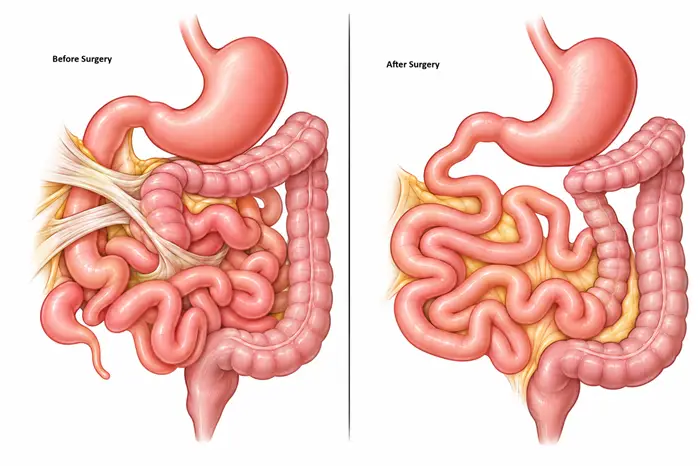
The Ladd Procedure is an operation performed to treat intestinal malrotation and prevent or treat midgut volvulus.
During the procedure, the pediatric surgeon:
The exact surgical approach depends on the child’s age, symptoms, anatomy, and whether bowel twisting or intestinal damage has occurred.
Intestinal malrotation develops during fetal growth. It is not usually caused by something the parents did during pregnancy.
The exact reason why normal intestinal rotation fails to occur in some babies is not always known.
Malrotation may occur by itself or alongside other congenital conditions, including certain abdominal wall, intestinal, cardiac, or other developmental abnormalities.
Symptoms can vary considerably depending on the child’s age and whether volvulus has developed.
Common warning signs include:
Green vomiting in a newborn or infant should be treated as an emergency and requires urgent medical evaluation.
Bilious vomiting can occur when an obstruction develops beyond the opening of the bile duct into the intestine.
Some children with malrotation may not develop symptoms until later in childhood. Possible symptoms include:
Some children may have no obvious symptoms and may be diagnosed while being evaluated for another abdominal condition.
Midgut volvulus is one of the most serious complications associated with intestinal malrotation.
Because the intestine has an abnormally narrow attachment, the bowel can twist around the mesenteric blood vessels.
This twisting may cause:
Midgut volvulus is a surgical emergency.
If a baby develops sudden green vomiting, abdominal swelling, severe irritability, bloody stools, unusual sleepiness, or other concerning symptoms, urgent medical assessment is required.
A pediatric surgeon may recommend a Ladd Procedure when intestinal malrotation is associated with symptoms or complications.
Common indications include:
When volvulus is suspected, treatment should not be unnecessarily delayed because the intestine may lose its blood supply.
The decision to operate on an incidentally discovered, symptom-free malrotation can be more individualized and depends on the child’s age, anatomy, overall health, and the pediatric surgeon’s assessment.
Diagnosis begins with the child’s medical history and physical examination.
Depending on the symptoms and clinical situation, investigations may include:
An upper gastrointestinal contrast study is commonly used to evaluate the position and movement of the stomach and duodenum.
It can help identify an abnormal position of the duodenojejunal junction and findings suggestive of malrotation.
Ultrasound may be useful in selected children. It can help assess the relationship between the superior mesenteric artery and vein and may provide other clues suggesting malrotation or volvulus.
An abdominal X-ray may be performed when intestinal obstruction or another abdominal emergency is suspected.
However, a normal X-ray does not necessarily exclude malrotation.
Blood tests may be performed to assess dehydration, infection, electrolyte abnormalities, inflammation, or other complications.
In an emergency, investigations are selected based on the child’s condition, and surgery may be required urgently when volvulus is strongly suspected.
The operation is performed under general anesthesia.
The surgical steps can vary depending on the anatomy and severity of the condition.
The surgeon accesses the abdominal cavity through either an open incision or, in selected cases, a minimally invasive laparoscopic approach.
The choice depends on the child’s condition, age, anatomy, and whether there is an emergency such as volvulus.
The surgeon carefully examines the bowel to identify malrotation, abnormal bands, twisting, and the condition of the intestinal blood supply.
If midgut volvulus is present, the intestine is carefully untwisted.
The direction and technique are determined by the surgeon according to the child’s anatomy.
Abnormal fibrous bands known as Ladd bands may cross the duodenum and contribute to intestinal obstruction.
These bands are divided to relieve the obstruction and allow the bowel to move more freely.
The surgeon widens the narrow mesenteric attachment to reduce the tendency of the intestine to twist again.
The intestines are placed in a non-rotated position that reduces the risk of another volvulus.
Typically, the small intestine is positioned predominantly on the right side and the colon on the left.
An appendectomy is commonly performed during the Ladd Procedure.
Because the appendix can be positioned abnormally after malrotation, removing it may help avoid confusion if the child develops abdominal symptoms later in life.
If volvulus has compromised blood flow, the surgeon evaluates whether the affected intestine remains viable.
If bowel tissue is severely damaged, removal of the non-viable segment may be necessary.
The goal is always to preserve as much healthy intestine as safely possible.
The Ladd Procedure can be performed using an open or laparoscopic approach.
Open surgery may be preferred when:
Laparoscopic surgery uses small abdominal incisions and specialized instruments.
It may be considered in selected children, particularly when the condition is stable and there is no severe bowel compromise.
Potential advantages can include:
However, laparoscopic surgery is not appropriate for every child. The safest approach depends on the child’s clinical condition and the surgeon’s assessment.
It can be.
When intestinal malrotation causes midgut volvulus, the condition is a surgical emergency because twisting can compromise the bowel’s blood supply.
The longer the blood supply remains impaired, the greater the risk of permanent intestinal injury.
For this reason, a child with suspected volvulus requires immediate medical evaluation and, when confirmed, urgent surgical management.
Like any abdominal surgery, the Ladd Procedure has potential risks.
Possible complications include:
The risk of complications depends significantly on whether the child has uncomplicated malrotation or presents with volvulus and bowel ischemia.
Recovery varies depending on the child’s age, overall health, surgical approach, and whether bowel damage occurred.
After surgery, the child may initially receive fluids through an intravenous line while the intestine gradually begins functioning again.
Feeding is usually restarted when the surgical team feels it is safe.
Parents may notice that:
Children who required removal of damaged intestine may need a longer hospital stay and additional nutritional support.
Regular follow-up helps monitor recovery and identify possible complications.
Parents should contact the medical team if the child develops:
Although the Ladd Procedure is designed to reduce the risk of recurrent volvulus, recurrent obstruction or volvulus can rarely occur.
The anatomical abnormality is corrected to reduce the risk of future twisting, but recurrent volvulus is possible in rare cases.
Parents should therefore remain aware of concerning gastrointestinal symptoms, especially recurrent vomiting or severe abdominal pain.
Any new symptoms should be evaluated by a pediatric medical professional rather than assumed to be a routine digestive problem.
Many children recover well after successful treatment, particularly when the bowel remains healthy and extensive intestinal removal is not required.
The long-term outcome depends largely on:
Early recognition and appropriate surgical treatment can be particularly important in children with acute volvulus.
A Ladd Procedure is a surgical operation used to treat intestinal malrotation and reduce the risk of midgut volvulus. It involves releasing abnormal bands, widening the mesenteric base, and repositioning the intestines.
Yes. Intestinal malrotation is a congenital condition that develops when the intestine does not complete its normal rotation and positioning during fetal development.
Green or bilious vomiting in a baby can indicate intestinal obstruction, including midgut volvulus, and requires urgent medical assessment.
Not necessarily. Management depends on the child’s symptoms, anatomy, age, associated conditions, and risk of complications. A pediatric surgeon should evaluate the individual situation.
The intestine can twist around its blood supply, causing obstruction and potentially cutting off blood flow. This can damage the bowel and requires urgent surgical treatment.
In selected children, a laparoscopic Ladd Procedure may be possible. However, open surgery may be preferred in emergency situations or when extensive bowel assessment is required.
Recovery varies from child to child. Children with uncomplicated cases may recover more quickly, while those with volvulus or damaged bowel may require a longer hospital stay and additional treatment.
Many children can have a good long-term outcome after successful treatment. Recovery and long-term health depend on whether bowel damage or other medical conditions were present.
Recurrence is uncommon but possible. New symptoms such as green vomiting, severe abdominal pain, abdominal swelling, or persistent vomiting require prompt medical evaluation.
Parents should seek urgent medical attention if a child develops green vomiting, severe or worsening abdominal pain, significant abdominal swelling, bloody stools, repeated vomiting, unusual sleepiness, or signs of dehydration.
Dr. Muni Varma offers advanced Pediatric Ladd Procedure (Intestinal Malrotation Surgery) for Children in Lucknow, India. With more than 10 years of experience, he uses a careful and child-focused approach to provide accurate evaluation, appropriate surgical planning, and better long-term care. He offers personalized treatment and follow-up support for children with intestinal malrotation and related complications, helping parents understand the treatment process and providing quality pediatric surgical care in Lucknow, India.
