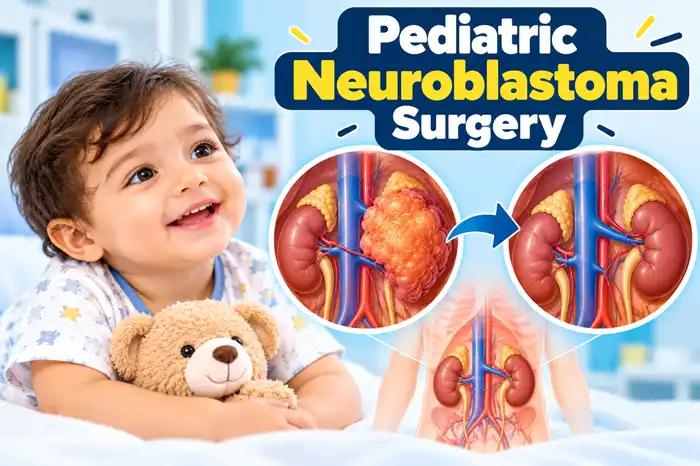
Pediatric Neuroblastoma Surgery is a surgical procedure used to remove a neuroblastoma tumor in children when the tumor can be safely and effectively removed. The operation may involve removing the tumor completely or, in some situations, removing as much of the tumor as safely possible while protecting nearby organs, blood vessels, nerves, and other important structures.
Neuroblastoma commonly develops from immature nerve cells and may occur in areas such as the adrenal gland or other parts of the abdomen, chest, neck, or pelvis. Because these tumors can sometimes surround or closely involve major blood vessels and other structures, the surgical approach is carefully planned using imaging and the child’s overall treatment plan.
Surgery is often one part of multidisciplinary neuroblastoma treatment and may be combined with chemotherapy, radiotherapy, stem-cell treatment, immunotherapy, or other therapies depending on the child’s risk group and response to treatment.
A pediatric surgeon and oncology team may consider surgery when:
The timing of surgery depends on the child’s age, tumor location, tumor biology, stage, response to chemotherapy, and involvement of surrounding structures.
The main goals of neuroblastoma surgery may include:
Complete tumor removal is not always possible or appropriate. In some children, attempting to remove every visible part of the tumor could cause significant injury to vital organs, blood vessels, nerves, or other structures.
Before surgery, the child undergoes detailed evaluation and imaging. CT or MRI scans may help the surgical team understand the tumor’s size, location, and relationship with nearby organs and blood vessels.
During surgery:
The exact procedure varies considerably depending on where the neuroblastoma is located and how closely it involves surrounding structures.
Open surgery uses an incision large enough to provide direct access to the tumor.
It may be considered when:
Open surgery allows the surgeon to directly visualize and carefully separate the tumor from important structures when possible.
For selected tumors, laparoscopic surgery may be considered.
Small incisions are used to introduce a camera and specialized surgical instruments. The surgeon removes the tumor through these small access points when the location and size of the tumor make minimally invasive surgery appropriate.
Laparoscopic surgery is not suitable for every child with neuroblastoma. Tumor size, location, involvement of blood vessels, and the need for safe complete or near-complete removal are important considerations.
When a neuroblastoma is located in the chest, thoracoscopic surgery may be considered in selected cases.
The surgeon uses small incisions and a camera to access the tumor inside the chest. The suitability of this approach depends on the tumor’s location, size, relationship with the spine and major structures, and the child’s overall condition.
The goal is not always to remove every visible portion of the tumor at any cost.
If a neuroblastoma surrounds major blood vessels or involves important nerves, aggressive removal may increase the risk of serious complications. In such situations, the surgical team may remove the maximum amount of tumor that can be safely removed.
The decision is individualized and made as part of the child’s overall oncology treatment plan.
Some children receive chemotherapy before surgery.
Preoperative chemotherapy may reduce the size of the tumor and make the operation safer or more manageable. After the tumor responds, surgery may be planned to remove the remaining tumor.
The timing of surgery depends on the child’s response and the treatment protocol recommended by the pediatric oncology team.
Depending on the location and characteristics of the tumor, nearby lymph nodes may be assessed or removed during surgery.
The pathology report can provide important information about whether tumor cells are present in the sampled lymph nodes and can help the oncology team determine the next steps in treatment.
The removed tumor is sent to a pathology laboratory.
Pathological examination helps determine important characteristics of the tumor and may be combined with other laboratory and molecular investigations. These findings can contribute to risk classification and help guide additional treatment.
Surgery is therefore not only about removing the visible tumor; the tissue obtained during the operation can also provide important information for ongoing cancer care.
Neuroblastoma can occur in infants, young children, and older children.
There is no single age at which surgery is performed. The timing depends on:
In some children, surgery is performed after initial medical treatment rather than immediately after diagnosis.
Neuroblastoma surgery can be safely performed in appropriately selected children when planned by an experienced pediatric surgical and oncology team.
However, neuroblastoma can sometimes be located close to major blood vessels, nerves, kidneys, intestines, or other important structures. Therefore, the risks vary considerably from one child to another.
The surgical team evaluates the tumor’s anatomy carefully before recommending the most appropriate approach.
Potential benefits include:
The expected benefit depends on the child’s tumor biology, stage, risk group, response to other treatments, and extent of surgical removal.
As with any major pediatric surgery, neuroblastoma surgery carries potential risks.
These may include:
The specific risks depend heavily on the tumor’s location and its relationship with surrounding structures.
Recovery depends on the child’s age, general health, tumor location, surgical approach, and extent of surgery.
After the procedure, the child may be monitored closely in the hospital. Pain control, nutrition, fluid balance, bowel and bladder function, and wound healing are carefully observed.
Some children may require intensive monitoring after major surgery.
The treating team will determine when the child can begin normal feeding, walking, and other activities.
Parents may be advised to:
If the child is continuing chemotherapy or another cancer treatment, those instructions should be followed alongside surgical aftercare.
Follow-up is an important part of treatment.
The child may require:
The exact follow-up schedule depends on the child’s neuroblastoma risk group and overall treatment plan.
Return to school, sports, and physical activities depends on the type of surgery and the child’s recovery.
Light activities may gradually resume once the child is comfortable and medically stable. Strenuous exercise, contact sports, and activities that place pressure on the surgical area may need to be avoided for a period recommended by the surgical team.
Children receiving chemotherapy or other treatments may have additional activity restrictions.
Children treated for neuroblastoma may require long-term follow-up even after successful completion of treatment.
Follow-up may include monitoring:
Long-term care is individualized according to the child’s treatment history.
Surgery alone does not cure every case of neuroblastoma.
Some children require a combination of surgery and other treatments such as chemotherapy, radiotherapy, immunotherapy, or additional cancer-directed therapies.
The overall treatment plan depends on the child’s risk classification, tumor biology, stage, response to treatment, and whether disease is present elsewhere in the body.
The cost of neuroblastoma surgery in India varies significantly from one child to another.
Factors that may affect the overall cost include:
Parents should discuss the expected treatment plan and estimated costs with the treating hospital before surgery.
Parents should understand that neuroblastoma treatment is usually planned according to the individual child’s risk profile rather than surgery alone.
Important questions to discuss with the treating team include:
A pediatric surgeon and pediatric oncology team can explain the expected benefits and risks based on the child’s individual condition.
Pediatric Neuroblastoma Surgery is an operation performed to remove a neuroblastoma tumor in a child when surgical treatment is considered appropriate as part of the overall treatment plan.
No. Treatment depends on the child’s risk group, tumor characteristics, stage, location, and response to other treatments. Surgery may be combined with or performed after other therapies.
Complete removal may be possible in some children, while in others the tumor may be closely associated with important structures. In such cases, the surgeon may remove as much tumor as can be safely removed.
Neither approach is universally better. Open, laparoscopic, or thoracoscopic surgery may be considered depending on tumor size, location, anatomy, and safety.
In some children, chemotherapy is given before surgery to reduce the tumor and make surgical removal safer or more effective.
Recovery varies depending on the child’s age, tumor location, extent of surgery, and overall treatment. The surgical team provides individualized guidance about hospital stay and activity restrictions.
Recurrence is possible depending on the child’s risk group and treatment response. Regular follow-up with the pediatric oncology team is therefore important.
Not necessarily. The need for chemotherapy, radiotherapy, immunotherapy, or other treatment depends on the child’s individual neuroblastoma risk classification and response to treatment.
Dr. Muni Varma offers advanced Pediatric Neuroblastoma Surgery for Children in Lucknow, India. With more than 10 years of experience, he uses a careful and child-focused approach to provide accurate evaluation, appropriate surgical planning, and better long-term care. He offers personalized treatment and follow-up support for children requiring tumor surgery, helping parents understand the treatment process and providing quality pediatric surgical care in Lucknow, India.
