Pediatric Ramstedt Pyloromyotomy is a surgical procedure used to treat infantile hypertrophic pyloric stenosis by releasing the thickened pyloric muscle that blocks the passage of milk or food from the stomach into the small intestine.
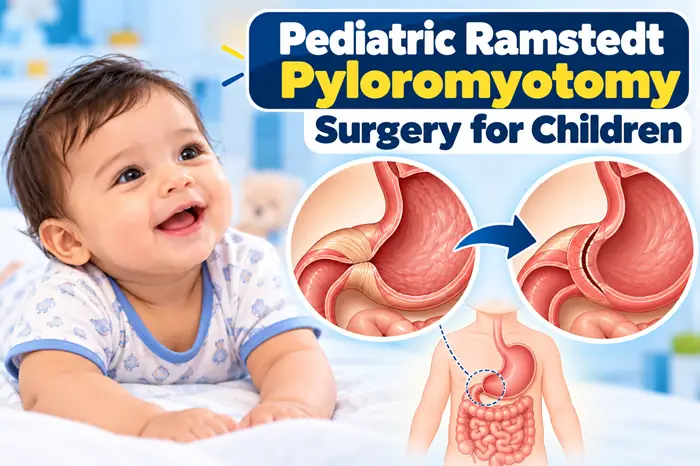
During the procedure, the surgeon makes a controlled incision through the thickened outer muscle of the pylorus while preserving the inner lining. This allows the pyloric channel to open and restores the passage between the stomach and small intestine.
Ramstedt pyloromyotomy can be performed through an open approach or using a laparoscopic approach with small abdominal incisions. The choice depends on the infant’s condition, anatomy, and the surgeon’s assessment.
Before surgery, dehydration and electrolyte abnormalities caused by repeated vomiting are usually corrected. Once the baby is medically stable, pyloromyotomy can be performed safely in most cases.
A baby may require pyloromyotomy when persistent vomiting is caused by pyloric muscle thickening that prevents normal gastric emptying.
Surgery may be recommended when:
The timing of surgery depends on the baby’s hydration, electrolyte levels, and overall condition.
The purpose of Ramstedt pyloromyotomy is to relieve the obstruction at the pylorus.
The procedure aims to:
The procedure does not remove the pylorus. Instead, the thickened muscle is divided to relieve the obstruction.
Before surgery, the baby is carefully assessed for dehydration and electrolyte abnormalities. Intravenous fluids may be given to restore hydration and correct abnormal blood electrolyte levels.
Once the baby is adequately stabilized, the operation is performed under general anesthesia.
During pyloromyotomy:
The goal is to release the muscle while avoiding injury to the underlying mucosa.
Open pyloromyotomy is performed through a small abdominal incision.
The surgeon identifies the enlarged pylorus and performs the muscle incision directly.
The open approach allows direct access to the pylorus and can be performed effectively in infants requiring surgical treatment for pyloric stenosis.
The incision is then closed after the pyloromyotomy has been completed.
Laparoscopic pyloromyotomy is a minimally invasive technique performed through small abdominal incisions.
A small camera and specialized instruments are used to identify the pylorus. The surgeon then performs the pyloromyotomy under direct laparoscopic visualization.
Potential advantages of the laparoscopic approach may include:
However, the appropriate approach depends on the infant’s condition, anatomy, previous abdominal procedures, and the surgeon’s experience.
Both open and laparoscopic approaches aim to achieve the same surgical goal: release the thickened pyloric muscle and restore the passage of feeds from the stomach into the intestine.
| Feature | Open Pyloromyotomy | Laparoscopic Pyloromyotomy |
|---|---|---|
| Incision | Small abdominal incision | Several small incisions |
| Visualization | Direct surgical access | Camera-assisted visualization |
| Scarring | Small scar | Usually smaller scars |
| Surgical approach | Open | Minimally invasive |
| Suitability | Widely used | Selected infants |
| Goal | Same | Same |
The pediatric surgeon chooses the approach based on the individual infant.
Infantile hypertrophic pyloric stenosis commonly presents during the first weeks of life, and pyloromyotomy is generally performed during infancy after the baby has been medically stabilized.
The operation is usually not delayed unnecessarily once the infant is adequately hydrated and electrolyte abnormalities have been corrected.
The exact timing depends on:
Ramstedt pyloromyotomy is a well-established surgical treatment for infantile hypertrophic pyloric stenosis.
As with any operation, complications are possible. Careful preparation before surgery is particularly important because repeated vomiting can cause dehydration and electrolyte disturbances.
The baby is monitored during and after surgery for breathing, feeding, hydration, and signs of complications.
The potential benefits of successful pyloromyotomy include:
The procedure directly addresses the muscular obstruction responsible for the problem.
Although pyloromyotomy is generally successful, complications can occur.
Possible complications include:
Persistent vomiting after surgery does not always indicate a failed operation. Some infants may continue to vomit temporarily as feeding is restarted and the stomach returns to normal function.
Most babies are monitored closely after surgery and feeding is gradually restarted according to the surgical team’s protocol.
Recovery may include:
Feeding schedules vary according to the baby’s condition and the hospital’s postoperative protocol.
Some babies may go home relatively soon after surgery once they are feeding adequately and medically stable.
Parents should follow the postoperative instructions provided by the pediatric surgical team.
Important aftercare measures may include:
Parents should seek medical advice if vomiting becomes persistent, forceful, or associated with poor feeding or reduced urine output.
Follow-up helps ensure that the baby is recovering appropriately after surgery.
The pediatric surgical team may assess:
Most infants gradually return to normal feeding and growth after successful treatment.
Because pyloromyotomy is performed in infants, normal activity generally resumes naturally as the baby recovers.
Parents may be advised to avoid unnecessary pressure on the surgical incision during the early healing period.
As the incision heals and the baby returns to normal feeding and activity, routine infant activities can usually be resumed according to the surgeon’s advice.
Yes. The purpose of pyloromyotomy is to relieve the obstruction and allow feeds to pass from the stomach into the small intestine.
Feeds are generally restarted gradually after surgery.
Some vomiting or feeding intolerance can occur temporarily after the operation. Persistent or worsening vomiting should be evaluated by the treating medical team.
The cost of Pediatric Ramstedt Pyloromyotomy in India varies depending on the hospital, surgical approach, baby’s medical condition, and length of hospitalization.
Factors that may influence the total cost include:
Parents should discuss the expected treatment plan and estimated cost with the treating hospital after the baby has been evaluated.
Parents should understand that pyloromyotomy is usually performed after the baby’s dehydration and electrolyte abnormalities have been corrected.
Before surgery, parents should discuss:
The pediatric surgeon can explain the surgical plan based on the baby’s condition.
Ramstedt pyloromyotomy is a surgical procedure used to relieve the thickened pyloric muscle that obstructs the passage of milk or food from the stomach into the small intestine.
It is performed during infancy, commonly in young babies diagnosed with infantile hypertrophic pyloric stenosis. The baby is generally stabilized before surgery.
It can be performed using either an open or laparoscopic approach. The appropriate technique depends on the baby’s condition and the pediatric surgeon’s assessment.
Open pyloromyotomy uses a small abdominal incision, while laparoscopic pyloromyotomy uses small incisions and a camera. Both procedures aim to release the thickened pyloric muscle.
Some vomiting may occur temporarily after surgery as feeding is restarted. Persistent, worsening, or forceful vomiting should be evaluated by the treating medical team.
Feeding is generally restarted gradually after surgery according to the baby’s condition and the hospital’s feeding protocol.
Recovery varies, but many infants can gradually return to normal feeding after a short period of postoperative monitoring.
Pyloromyotomy is intended to permanently release the abnormal muscular obstruction. Follow-up is used to ensure that feeding and recovery progress appropriately.
Dr. Muni Varma offers advanced Pediatric Ramstedt Pyloromyotomy for Children in Lucknow, India. With more than 10 years of experience, he uses a careful and child-focused approach to provide accurate evaluation, appropriate surgical planning, and better long-term care. He offers personalized treatment and follow-up support for infants requiring pyloromyotomy, helping parents understand the treatment process and providing quality pediatric surgical care in Lucknow, India.
