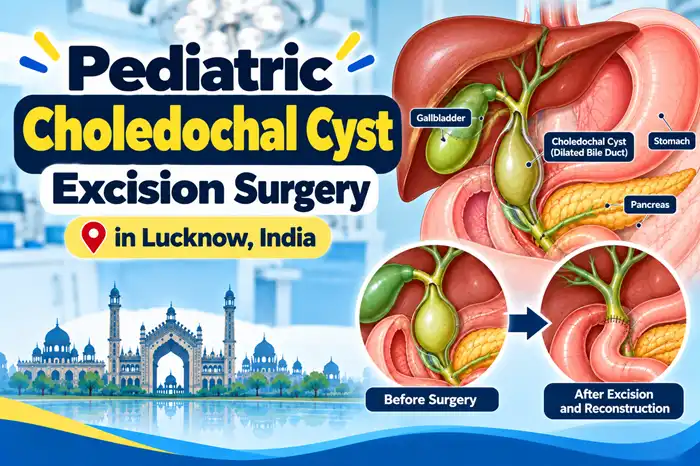
Pediatric Choledochal Cyst Excision is a surgical procedure used to remove an abnormal cystic or fusiform dilation of the bile duct and reconstruct the pathway through which bile flows from the liver into the intestine.
The standard surgical treatment for many extrahepatic choledochal cysts involves complete excision of the extrahepatic cyst and bile duct, followed by reconstruction of bile drainage, most commonly with a Roux-en-Y hepaticojejunostomy.
The operation may be performed using an open or laparoscopic approach, depending on the child’s age, anatomy, cyst characteristics, previous surgery, and the surgeon’s assessment.
The goal is to remove the abnormal bile duct tissue, establish effective bile drainage, and reduce the risk of future complications associated with the cyst.
Surgical excision is generally recommended for a choledochal cyst because leaving the abnormal extrahepatic bile duct in place can lead to ongoing biliary complications.
Surgery may be recommended when a child has:
The timing and surgical approach depend on the individual child’s condition.
The main purpose of surgery is to remove the abnormal bile duct and establish a healthy pathway for bile drainage.
Surgery aims to:
Complete excision is important because simply draining the cyst does not address the underlying abnormal bile duct.
The exact operation varies according to the anatomy of the cyst.
In general:
The precise steps depend on the child’s anatomy and the extent of biliary involvement.
Complete excision of the extrahepatic choledochal cyst is an important part of definitive treatment.
The surgeon removes the abnormal cystic or dilated bile duct while preserving the healthy intrahepatic bile ducts as much as possible.
Complete removal helps eliminate the abnormal tissue responsible for the cyst and allows reconstruction of bile drainage.
The exact level of dissection is determined by the cyst’s anatomy and its relationship with the pancreatic and hepatic ducts.
After removing the extrahepatic bile duct, bile needs a new pathway into the intestine.
A Roux-en-Y hepaticojejunostomy is commonly used for this reconstruction.
During this procedure:
This reconstruction establishes a new route for bile drainage after cyst excision.
Laparoscopic choledochal cyst excision uses small abdominal incisions rather than a larger open incision.
A camera and specialized instruments are inserted through the small ports.
The surgeon carefully dissects and removes the cyst and performs the biliary reconstruction using laparoscopic techniques when appropriate.
Potential advantages of a laparoscopic approach may include:
However, laparoscopic surgery is not suitable for every child, and complex anatomy or difficult dissection may require an open approach.
Open surgery uses an abdominal incision to provide direct access to the bile ducts and surrounding structures.
Open excision may be considered when:
The goal remains complete cyst excision followed by appropriate biliary reconstruction.
| Feature | Laparoscopic Approach | Open Approach |
|---|---|---|
| Incision | Several small incisions | Larger abdominal incision |
| Visualization | Camera-assisted | Direct surgical exposure |
| Scarring | Generally smaller | Generally more visible |
| Recovery | May be faster in selected cases | May require longer recovery |
| Suitability | Depends on age and anatomy | Useful for complex cases |
| Reconstruction | Can be performed laparoscopically in experienced centers | Performed through open access |
The choice of approach should be based on the child’s anatomy, cyst complexity, surgical expertise, and overall condition.
In many cases, the gallbladder is removed along with the extrahepatic cyst and abnormal bile duct.
This is because the gallbladder and extrahepatic bile duct are part of the abnormal biliary anatomy being reconstructed.
The exact surgical plan depends on the child’s anatomy and the location of the cyst.
Choledochal cyst excision can be performed in infants, children, or older patients when indicated.
In children, surgery is generally planned after appropriate evaluation rather than waiting for the child to reach a particular age.
The timing may depend on:
Children with significant complications may require earlier surgical treatment.
Choledochal cyst excision is an established pediatric hepatobiliary operation, but it is technically complex because the bile ducts lie close to important blood vessels and the pancreas.
Potential risks depend on the child’s anatomy, inflammation, cyst complexity, surgical approach, and overall health.
Careful preoperative imaging and experienced surgical planning are important.
Potential benefits include:
Possible complications include:
Although uncommon, complications involving the bile duct reconstruction may require further treatment.
Recovery depends on the child’s age, surgical approach, and complexity of the reconstruction.
After surgery, the child is monitored for:
Feeding is generally restarted gradually according to the child’s recovery.
Children undergoing laparoscopic surgery may recover more quickly than those requiring complex open surgery, although recovery varies from child to child.
After discharge, parents should:
Parents should contact the medical team promptly if the child develops significant abdominal pain, fever, jaundice, persistent vomiting, or other concerning symptoms.
Follow-up is important even after successful cyst removal.
The child may require monitoring of:
Ultrasound, blood tests, or other imaging may be recommended depending on the child’s clinical condition.
Complete removal of the extrahepatic choledochal cyst is intended to provide definitive treatment, so recurrence of the excised cyst itself is uncommon.
However, children may develop later biliary problems such as:
Long-term follow-up helps detect these problems if they occur.
Most children can live normally after successful choledochal cyst excision and biliary reconstruction.
However, continued medical follow-up may be recommended to monitor:
The long-term outlook depends partly on the child’s biliary anatomy and the presence of complications before surgery.
The timing depends on the surgical approach and the child’s recovery.
Light activities can generally be resumed gradually after the initial recovery period.
Strenuous exercise, contact sports, and activities that place pressure on the abdomen may need to be avoided temporarily.
The surgeon will provide individualized advice about returning to school, sports, and other activities.
The cost of Pediatric Choledochal Cyst Excision in India varies depending on the complexity of the condition and the surgical approach.
Factors that may affect the cost include:
Parents should discuss the complete treatment plan and estimated cost with the pediatric surgical team.
Before surgery, parents should understand:
Parents should understand that the operation involves both removal of the abnormal bile duct and reconstruction of bile drainage.
Pediatric Choledochal Cyst Excision is surgery to remove an abnormal dilation of the bile duct and reconstruct the pathway for bile to flow from the liver into the intestine.
For many extrahepatic choledochal cysts, complete excision of the abnormal extrahepatic bile duct is the standard definitive surgical approach.
It is a biliary reconstruction procedure in which a segment of the small intestine is connected to the hepatic ducts so bile can drain directly into the intestine after removal of the extrahepatic bile duct.
Yes. Laparoscopic excision and reconstruction can be performed in appropriately selected children by experienced pediatric surgical teams.
Yes. Open surgery may be preferred when the cyst is complex, inflammation or adhesions are significant, or the anatomy makes a minimally invasive procedure unsuitable.
In many cases, the gallbladder is removed along with the abnormal extrahepatic bile duct. The exact surgical plan depends on the child’s biliary anatomy.
Many children can return to normal daily life after successful surgery and recovery. Regular follow-up may still be recommended to monitor long-term biliary health.
Potential complications include bile leakage, infection, pancreatitis, cholangitis, and narrowing at the biliary-intestinal connection.
Recovery varies depending on the child’s age, surgical approach, and complexity of reconstruction. Laparoscopic surgery may allow a faster recovery in selected cases.
Yes. Follow-up may be recommended to monitor liver function, bile drainage, the reconstructed bile duct pathway, and possible late complications.
Dr. Muni Varma offers advanced Pediatric Choledochal Cyst Excision for Children in Lucknow, India. With more than 10 years of experience, he uses a careful and child-focused approach to provide accurate evaluation, appropriate surgical planning, and better long-term care. He offers personalized treatment and follow-up support for children requiring choledochal cyst surgery, helping parents understand the treatment process and providing quality pediatric surgical care in Lucknow, India.
