Gastroschisis is a congenital abdominal wall defect in which a baby is born with an opening in the abdominal wall, usually to the right of the umbilicus. Through this opening, the intestine develops outside the abdomen without being covered by normal skin.
The exposed intestine can become swollen, irritated, and difficult to return into the abdominal cavity immediately after birth. Some babies may also have associated intestinal problems such as atresia or other abnormalities.
Pediatric gastroschisis repair surgery is performed to protect the exposed intestine, return the bowel into the abdominal cavity and close the abdominal wall defect. Depending on the condition of the baby and the bowel, repair may be performed in one operation or gradually using a silo.
At the pediatric surgery practice of Dr. Muni Varma, children with gastroschisis are evaluated individually because the condition and the amount of intestinal involvement can vary considerably from one baby to another.
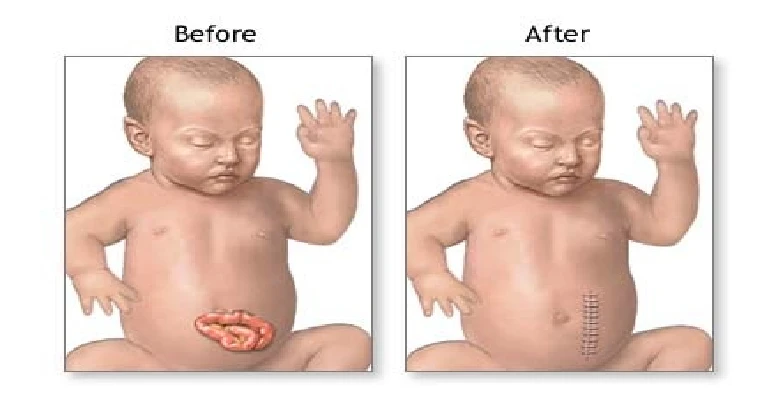
Gastroschisis requires surgical management because the intestine is outside the abdominal cavity and needs to be protected and returned to its normal position.
The timing and method of repair depend on:
The pediatric surgical team first stabilizes the baby and protects the exposed bowel before deciding whether primary closure or staged repair is appropriate.
The purpose of surgery is not simply to close the abdominal wall.
A properly planned repair aims to:
The exact surgical plan depends on the baby’s anatomy and the condition of the intestine.
The surgical technique depends mainly on the amount of bowel outside the abdomen, the condition of the intestine and whether the baby’s abdomen can safely accommodate the bowel.
Before surgery, the exposed intestine is carefully protected and the baby is stabilized.
During the repair, the surgeon examines the bowel and gently returns it into the abdominal cavity when this can be done safely.
If the bowel cannot be returned all at once without creating excessive pressure, a staged repair using a silo may be performed.
The abdominal wall is then closed once the bowel has been safely positioned.
Primary closure means returning the exposed intestine into the abdominal cavity and closing the abdominal wall during the initial operation.
The surgeon carefully evaluates the bowel before reducing it into the abdomen.
If the abdominal cavity can accommodate the bowel without excessive pressure, the intestine is gently returned and the abdominal wall defect is closed.
Primary closure may be considered when:
The aim is to achieve a secure closure while protecting breathing, circulation and bowel function.
A silo is a sterile protective pouch used when the intestine cannot safely be returned into the abdomen during one operation.
The exposed bowel is placed inside the silo, which protects the intestine while allowing gradual movement of the bowel back into the abdominal cavity.
Instead of forcing all of the bowel inside at once, the surgeon gradually reduces it over a period of time.
Once the intestine has been returned sufficiently, the abdominal wall defect is closed.
In a staged repair, the exposed intestine is first placed inside a silo.
The silo is secured around the abdominal wall opening and the bowel is gradually reduced into the abdomen.
The surgical and neonatal teams closely monitor the baby during this process.
They may monitor:
Once the bowel has been safely returned into the abdominal cavity, the abdominal wall can be closed.
A silo may be considered when the exposed intestine is too swollen or the abdominal cavity is too small to allow safe primary closure.
It can be particularly useful when returning all of the bowel at once could increase pressure inside the abdomen and interfere with breathing or circulation.
The decision to use a silo is based on the baby’s condition and the surgeon’s assessment during treatment.
The exposed intestine can sometimes be significantly swollen or affected by associated intestinal problems.
Some babies with gastroschisis may have intestinal atresia, narrowing, perforation or other bowel complications.
If an abnormal intestinal segment is identified, the surgical plan may need to be modified.
The surgeon aims to preserve as much healthy intestine as possible because adequate bowel length is important for future feeding and nutrition.
Gastroschisis repair is performed in the newborn period because the intestine is exposed outside the abdominal cavity from birth.
The timing of the operation depends on the baby’s overall condition and whether primary or staged closure is considered appropriate.
In some babies, the bowel can be repaired shortly after birth. In others, a silo is used and the repair is completed gradually.
Gastroschisis repair is an established pediatric surgical procedure, but newborns with gastroschisis can have complex medical and surgical needs.
Possible complications can include:
The likelihood of complications depends on the condition of the bowel, whether the gastroschisis is simple or complex, and the baby’s overall health.
Parents should discuss the expected benefits and possible risks with the pediatric surgeon before surgery.
Children usually require close monitoring after gastroschisis repair, particularly during the initial recovery period.
The intestine may take time to begin functioning normally after being returned to the abdominal cavity.
The baby may initially require nutritional support through an intravenous route before feeds can be introduced.
The surgical team may advise parents about:
Feeds are generally introduced gradually as the intestine begins to function.
The recovery period is different for every baby and depends on the type of repair and whether associated bowel problems are present.
Follow-up is an important part of gastroschisis treatment.
The pediatric surgical team monitors healing, feeding, bowel function, growth and nutritional status.
Parents should contact the treating team if they notice problems such as:
Early evaluation can help identify complications and allow appropriate treatment.
Yes. Some babies may take time to establish normal feeding after surgery because the intestine can be swollen and temporarily slow to function.
Babies may require intravenous nutrition while bowel function recovers.
Feeds are generally introduced gradually according to the child’s tolerance and clinical condition.
Most babies with uncomplicated gastroschisis can eventually establish enteral feeding, although complex cases may require longer nutritional support.
The long-term outcome depends largely on the condition and length of the intestine.
Children with simple gastroschisis often have a good long-term outlook after successful repair.
Children with complex gastroschisis, particularly those with intestinal atresia or significant bowel damage, may require closer nutritional and gastrointestinal follow-up.
A diagnosis of gastroschisis can be frightening for parents, especially when they see the intestine outside their baby’s abdomen.
It is important to understand that the surgical plan can vary significantly between babies.
Before surgery, parents can discuss:
Having these questions answered can make the treatment process easier to understand.
Yes. Gastroschisis is a congenital condition that develops before birth and is usually identified during pregnancy or immediately after delivery.
Yes. Surgical management is required to protect the exposed bowel, return it to the abdominal cavity and close the abdominal wall defect.
Primary closure involves returning the exposed intestine into the abdominal cavity and closing the abdominal wall during the initial repair when this can be done safely.
A silo is a sterile protective pouch used to contain the exposed intestine when the bowel cannot safely be returned to the abdomen all at once.
Staged repair allows the intestine to be gradually returned to the abdominal cavity. It can help avoid excessive pressure inside the abdomen when the bowel is swollen or the abdominal cavity is relatively small.
The timing varies. Some babies can undergo primary closure, while others require gradual reduction using a silo before final closure.
Yes. Some babies may have associated problems such as intestinal atresia, narrowing, perforation or other abnormalities.
Some babies require intravenous nutritional support while the intestine recovers and before adequate milk feeding can be established.
The original abdominal wall defect does not usually return after successful repair. However, complications such as adhesions or intestinal obstruction can occur in some children.
Some children, particularly those who had complex gastroschisis, may require longer-term monitoring for feeding, nutrition, bowel function and growth.
Dr. Muni Varma offers advanced Gastroschisis Repair Surgery for Children in Lucknow, India. With more than 10 years of experience, he uses a careful and child-focused approach to provide accurate evaluation, appropriate surgical planning, and better long-term care. He offers personalized treatment and follow-up support for children with gastroschisis, helping parents understand the treatment process and providing quality pediatric surgical care in Lucknow, India.
