Pediatric Kasai Procedure (Biliary Atresia Surgery) is a specialized operation used in infants with biliary atresia, a rare condition in which the bile ducts that carry bile from the liver to the intestine become blocked or do not develop normally.
When bile cannot flow out of the liver, it can build up and progressively damage liver tissue. Biliary atresia is a serious condition that requires early diagnosis and treatment.
The Kasai procedure aims to restore bile drainage from the liver into the intestine and may help delay or prevent the progression of liver damage. The outcome is influenced by several factors, including the child’s age at surgery and the condition of the liver.
Dr. Muni Varma evaluates infants with suspected biliary atresia and works with the appropriate pediatric medical team to determine the required treatment approach.
Biliary atresia is a rare disease that affects newborn babies and infants. In this condition, the bile ducts outside the liver become blocked, scarred or absent.
Bile is produced by the liver and normally travels through the bile ducts into the intestine. When this pathway is blocked, bile cannot drain normally.
The resulting accumulation of bile can cause progressive liver injury and, without treatment, may eventually lead to cirrhosis and liver failure.
The symptoms may appear during the first weeks of life.
Important signs include:
Persistent jaundice in an infant should always be medically evaluated, particularly when associated with pale stools or dark urine.
Biliary atresia can progress quickly and cause ongoing liver damage.
Early diagnosis allows the medical team to assess the infant and determine whether a Kasai procedure is appropriate.
The timing of surgery is one of the factors associated with outcomes after the procedure, although the condition of the liver and other individual factors also play important roles.
Diagnosis generally requires several investigations because persistent jaundice in an infant can have many causes.
The evaluation may include:
The final diagnosis may be established during surgery when the bile ducts are directly assessed.
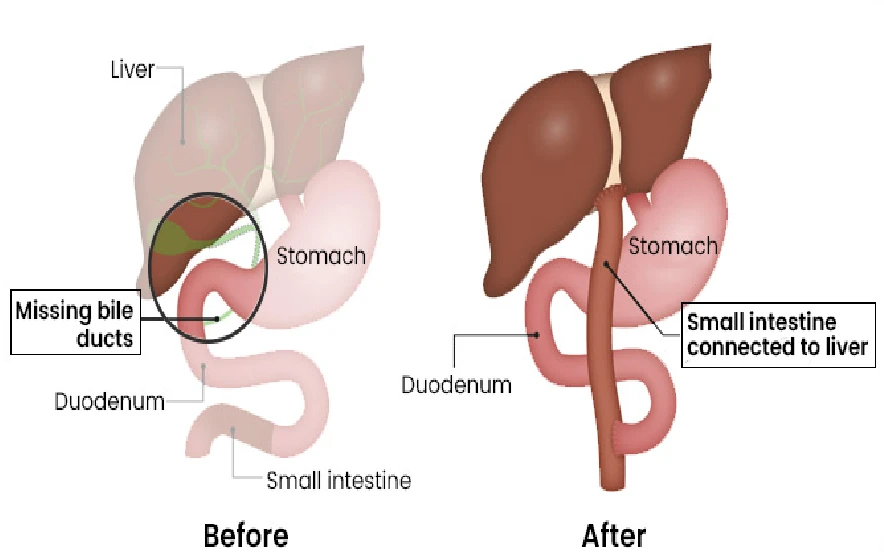
The Kasai procedure, also known as hepatoportoenterostomy, is a surgical procedure designed to establish a new pathway for bile drainage.
During the procedure, the surgeon removes the damaged or blocked extrahepatic bile ducts and connects a loop of the small intestine directly to the area at the liver’s bile duct drainage point.
The goal is to allow bile to flow from the liver into the intestine without relying on the damaged bile ducts.
The operation is performed under general anesthesia.
The surgeon examines the liver and bile duct structures and confirms the findings using appropriate surgical assessment.
The abnormal extrahepatic bile duct tissue is removed, and a carefully prepared segment of the small intestine is brought up and connected to the area where bile drains from the liver.
This creates a new route through which bile can reach the intestine.
The exact surgical approach depends on the infant’s anatomy and the findings during the operation.
Intraoperative cholangiography is an imaging procedure that may be performed during surgery to examine the bile ducts.
A contrast material is introduced into the biliary system to determine whether the bile ducts are open and how they are structured.
This can help the surgical team confirm the diagnosis and plan the appropriate operation.
The Kasai procedure is not considered a guaranteed cure for biliary atresia.
Its purpose is to establish bile drainage and preserve liver function for as long as possible.
Some infants achieve good bile flow after surgery and may maintain their own liver for many years. Others may continue to develop progressive liver disease and eventually require liver transplantation.
Long-term follow-up is therefore essential.
After surgery, the infant requires close medical monitoring.
The medical team may monitor:
Medications may be prescribed to support bile flow, prevent or treat infection and provide nutritional support, depending on the child’s condition.
Cholangitis is an infection involving the bile drainage system and is an important complication that can occur after the Kasai procedure.
Parents should seek medical attention if the baby develops:
Prompt medical assessment is important when cholangitis is suspected.
Yes, Some children with biliary atresia continue to develop liver damage despite a Kasai procedure and may eventually require a liver transplant.
The need for transplantation depends on factors such as bile drainage after surgery, liver function, complications of chronic liver disease and the child’s long-term response to treatment.
The Kasai procedure can sometimes delay the need for transplantation and may allow a child to grow while using their own liver.
Earlier diagnosis and treatment are generally associated with better chances of establishing effective bile drainage.
However, age at surgery is not the only factor affecting the outcome. The severity of liver disease, anatomy and response to surgery also matter.
For this reason, infants with persistent jaundice and suspected biliary atresia should be evaluated promptly by an experienced pediatric team.
The Kasai procedure is a major pediatric operation and, like any surgery, has potential risks.
Possible complications include:
The risks and expected outcomes vary from child to child.
Good nutrition is particularly important for infants with biliary atresia because chronic liver disease can interfere with normal nutrient absorption and growth.
Depending on the child’s condition, the medical team may recommend:
Growth and nutritional status are monitored regularly.
Children who undergo a Kasai procedure require long-term follow-up.
The medical team may regularly monitor:
Even when bile drainage improves after surgery, ongoing monitoring remains important.
Biliary atresia is a rare condition in infants in which the bile ducts become blocked, scarred or do not develop normally, preventing bile from flowing properly from the liver to the intestine.
The Kasai procedure, or hepatoportoenterostomy, creates a new pathway for bile to drain from the liver into the intestine.
Persistent jaundice, pale or clay-colored stools and dark urine are important warning signs. Poor feeding and poor weight gain may also occur.
The procedure aims to restore bile drainage and reduce the ongoing accumulation of bile in the liver.
The Kasai procedure does not guarantee a permanent cure. Some children achieve good bile drainage, while others may develop progressive liver disease and eventually require liver transplantation.
Persistent jaundice in an infant, particularly with pale stools and dark urine, should be evaluated promptly because biliary atresia can progress quickly.
Yes. Cholangitis is an infection that can occur after surgery and requires prompt medical treatment.
Some children have good bile drainage and can live for many years with their own liver. Others may develop complications and require ongoing treatment or liver transplantation.
No. Some children maintain adequate liver function after a successful Kasai procedure. Others may eventually require transplantation depending on how their liver responds.
Biliary atresia can continue to affect the liver even when bile drainage improves. Regular follow-up helps monitor liver function, growth, nutrition and possible complications.
Dr. Muni Varma offers specialized Pediatric Kasai Procedure (Biliary Atresia Surgery) for Children in Lucknow, India. With more than 10 years of experience in pediatric surgery, he uses a careful and child-focused approach to provide timely evaluation, appropriate surgical planning, and coordinated long-term care. He offers personalized treatment and follow-up support for infants with biliary atresia, helping parents understand the condition, surgical process and ongoing care requirements while providing quality pediatric surgical care in Lucknow, India.
